



|
|
|
|
|
The composition of the set of manuscripts that Voynich acquired from the Society of Jesus in 1911 and/or 1912, and which included the 'Voynich MS', is explored in detail on this page, which will be referred to as the 'main page' in the following.
That page already goes into some detail about some of the manuscripts, but additional information has been collected on the present page. Its main purpose is to avoid that the main page becomes overloaded with content that is only marginally useful for its purpose.
Manuscript references use the manuscript numbering ("Jnn") of Manuscript Table 2 on the main page.
In its initial version of mid January 2026, this page is still very much in draft form. It is expected to be under development for some time.
The oldest sources are the bibliographical paper slips that Voynich took from a number of his manuscripts, which were written before 1870, while the books were in the Collegium Romanum library. These paper slips also include later annotations in pencil, written by Anne Nill sometime after 1937.
Next is the manuscript list of the Jesuits, now preserved as APUG 3289 (1). Also here, we must distinguish between two types of information: the original text penned while the manuscripts were preserved in the Villa Torlonia in Castel Gandolfo, and later annotations in pencil in the right margin, made by Vatican librarian Mgr. J. Ruysschaert, tentatively identifying their later whereabouts.
Both pencilled annotations by Anne Nill and Mgr Ruysschaert make frequent references to De Ricci's 'Census' (2). These may have been made independently by Nill and Ruysschaert, but it is possible that there has been some exchange of information between them. We can be certain that Anne Nill did not see APUG 3289 or its copy, but she was intimately familiar with De Ricci's Census as she was involved in composing its index (3). Her tentative MS identifications may well have reached Ruysschaert through correspondence. It would be of interest if such correspondence were found.
A further early source of information is a sales catalogue of De Marinis from 1913 (4). Important later sources are De Ricci (1937) and Ruysschaert (1959) (5). The relevant text of the latter is footnote 3 on page vii, which has been transcribed here. For brevity, the frequent references to this text are given as "Ruys.59" in the following.
Ruys.59 refers to De Marinis (1913) as "Manuscrits ..." (after a first quote of the complete title). Another reference used by Ruysschaert is De Marinis (1947-1952) (6).
In recent years, the Schoenberg Database of Manuscripts (SDBM) has been set up and maintained at the Univerity of Pennsylvania. Manuscript links to this database have recently been added to the main page. The present page includes many more detailed links.
This database has different record types. Manuscript records refer to a physical manuscript that is mentioned in several other SDBM records. Source records refer to catalogues or collections of documents. Name (authority) records refer to agents who can be (among others) authors, sellers or buyers. Entry records refer to appearances of manuscripts in sources. Typically, a manuscript record includes links to all entry records referring to it, and an entry record refers back to the manuscript record (if known) and the source in which it is mentioned.
This description is probably inadequate and will be revised as needed.
In the course of the research described here and on the main page, I have added a number of entries to the SDBM myself. Such entries are marked with a dagger symbol (†) in the present page.
While the SDBM references are all derivative from other documents, they provide a much more complete trace of each of the manuscripts than is included in the present page. The most important sources in the SDBM have been summarised here.
The original bibliographical slip of the MS is preserved in the Beinecke library, and says:
AEliani opus de instruendis aciebus ex graeco in latinum conversum a Theodoro Graeco thessalonicensi Codex membranac. in fol. po. Ms. saec. XV. cum ornatu et stemmate gentilicio in prima pagina depictis, et cum pluribus initialibus aureis. Constat foliis scriptis 64.
Anne Nill's annotations:
Not in Census of MSS.
With the arms of Alphonso of Aragon, King of Naples. De Marinis cat. (1913) no.2.
This MS is identified in APUG 3289 (original text) as:
Aelianus / Opus de instruendis aciebus - versio Latina Theodori codex membran in fol saec XV
Marginal note:
De Marinis, 3-5 [or 7]
In Ruys.59:
T. De Marinis, La biblioteca napoletana dei re d'Aragona, t. 2, Milano, 1947, pp. 3-5 (Aelianus; olim S. Galli, Collectio Arnold Mettler; = Manuscrits ..., no. 2, nunc Bodleianus Latinus class. d. 38, ut refert The Bodleian Library Record, t. 5 (1956), p. 332);
This MS does not appear in De Ricci.
Anne Nill mentions that this MS appears in De Marinis' 1913 catalogue as Nr. 2. Ruysschaert mentions both of De Marinis' documents - the 1913 catalogue as nr 2 and the 1947 volume on pp. 3-5. I have seen both and can confirm the positive match. This is also true of all other references to the two sources of De Marinis.
This MS is one of seven manuscripts that appear in De Marinis (1913), and which were evidently passed on to De Marinis after Voynich acquired them. The details of these seven manuscripts are summarised here.
In De Marinis (1947) the description includes the following:
Appartenne ad Enrico Benedetto Stuart Cardinale d'York, ultimo della Casa regnante degli Stuart, vescovo di Frascati (1725-1807), appassionato raccoglitore di antichi manoscritti lasciati poi alla sua Sede Vescovile. Acquistato in Roma da W. M. Voynich libraio in Londra comparve poi nel catalogo XII (Firenze 1913) della libraria T. De Marinis & C. dove è descritto al n.2 accompanato da una tavola;
The quoted ownership by Cardinal Henry Benedict Stuart is certainly not correct, but probably corresponds with what Voynich told De Marinis, as Voynich was not allowed to divulge the true origin of the manuscripts.
From De Marinis' work we know that this MS used to belong to the library of Alfonsus V of Aragon and Naples, before it entered the Collegium Romanum library. At some point the MS was sold to the Bodleian Library, where it is now preserved as MS class. d.38.
The >>MS record
The >>bibliographical paper slip entry
The >>entry in APUG 3289 (†)
The >>De Marinis (1913) entry
The original bibliographical slip of the MS is preserved in the Beinecke library, and says:
Alfragani Astronomia
Codex membranac. in 4°, Ms.Saec. XIII. et XIV. Constat foliis scriptis 154.
Anne Nill's annotations:
= Voynich M 7111
This MS is identified in APUG 3289 (original text) as:
Afraganus / astronomia c.membr. S.XIII et XIV
Marginal note:
Census 1845 [plus erased: 3 ? ]
In Ruys.59:
[S. De Ricci tomus 2,] p. 1845 (The estate of Wilfrid M. Voynich, New York, Ms. 1); p. 1845 (Ibid., Ms. 2);
De Ricci t.2, p. 1845 (The estate of W.Voynich) item 1 says:
1. Alfraganus, de scientia astrorum et radicibus motuum coelestium (ff. 3r. - 27v.), followed by a number of short astronomical treatises, including Almacherita, Liber astrolabii (ff.29r.-44r.); Thebith, De moti octavae sphaerae (ff. 65r.-69r. and again, by another hand, ff.73r.-74r.). Vel. (XIIIth and XIVth c.), 163 ff. (21 x 15 cm.). Written in Italy. Old vellum binding, lined at the beginning (ff.1-2) with a folded fragment of an act of sale, transferring some lands de Carescu et Ilcisca to a monastery of St.Leucius..
Anne Nill identified this item with a MS that had Voynich's internal catalogue number 7111, and Ruysschaert identified it with MS 1 of the estate of Voynich. These may or may not be the same item. The MS named by Ruysschaert can be positively identified with present-day Columbia Univ. Rare Book and Manuscript Library, Smith Western Add. MS 06. This is beyond all doubt, not only because it has 163 folios, but especially because it also includes the land sales act.
However, there can be some doubt whether this is the same MS that was sold by the Jesuits, because that is listed as 'in quarto', which does not really match with 21 x 15 cm, and it has 154 written pages, not 163. On the other hand, the 13th (or 14th) century is a positive match.
There is considerable correspondence in the Grolier Club between Anne Nill and Francis Carmody of the Univ. of California Berkeley, related to the MS with Voynich's internal catalogue nr. 7111. Among this is a hint that the MS could have been confused with a MS listed by De Ricci as Garrett nr. 99. The latter MS is found on page 884. It has 237 folios, so certainly is not the same as the MS sold by the Jesuits.
At this point, the identification of the Jesuit MS with the Columbia Univ. MS must be considered tentative at best. This should be further elaborated.
The >>bibliographical paper slip entry
The >>tentative entry in De Ricci
This MS is identified in APUG 3289 (original text) as:
Alphonsi regis Castellae / Tabulae astronomicae cod. membr s. XV
Marginal note:
Census 1899 [1845 erased]
In Ruys.59:
[S. De Ricci tomus 2,] p. 1845 (The estate of Wilfrid M. Voynich, New York, Ms. 1); p. 1845 (Ibid., Ms. 2);
Ruysschaert's handwritten annotation in APUG 3289 has two entries, one for De Ricci p.1845 and one for p.1899, where he appears to prefer the latter. In his printed catalogue, there is only reference to (t.2) p.1845 (The estate of W.Voynich) item 2, which is:
2. Alfonsus X, of Castile, Tabulae astronomicae (ff. 28r-58v.), with additional matter, including (ff.59v-60r.) the Tabulae magnitudinis et parvitatis diei ad meridianum Florentium. Vel. (ff.1 and 28-71) and pap. (XVth c.), 93 ff. (30x22 cm.). Written in Italy (Florence). Modern blue mor.
This MS is indeed of the 15th century and on parchment (at least in the beginning), but it is as yet unknown what happened with this MS, at that time in the estate of Voynich.
In t.2 on p.1899 we find MS Kane 51:
51. Alfonso X of Castile, Tabulae astronomicae [etc]
Ff. 1.22 (old foliation 9-30), obtained from W.M. Voynich; ff. 23-42 (old foliation 31-50)
discovered by L.C. Harper, are described by J. Rosenthal, Cat. 90 (1928), n. 152, pl.XI.
This MS is on parchment, but no century of origin is given.
From the detailed Princeton catalogue by Skemer (7), we know that the MS had been broken up into three parts, of which Voynich only acquired one, so we can be certain that this does not correspond with the Jesuit MS.
The >>tentative entry in De Ricci
The >>MS record for Kane 51
(not the Jesuit MS).
The >>Rosenthal Cat.90
This MS is identified in APUG 3289 (original text) as:
[Anonym.] / Ordini della repubblica de Venezia al capite di Vincentia c. membr. s. XVI
Marginal note:
Cat De Marinis N. 11
In Ruys.59:
Manuscrits ... no. 11.
In De Marinis (1913) item 11 is described on p.16 as on parchment of the 16th century, and a photo of its cover is provided as plate V.
This entry has not (yet) been identified in De Ricci.
The fate of this MS remains unknown. Unsold items of De Marinis were transferred in 1924 to Hoepli. The MS will be easily recognisable from its cover, as shown in De Marinis (1913).
In the SDBM, the MS is tentatively identified with codex MSS 247 in Michigan State University, but this appears very unlikely, as that MS traces back to Sir Thomas Phillipps, and appears in a Sales catalogue of 1913, the same year as De Marinis' catalogue. Remarkably, numerous properties of the two descriptions coincide:
On the other hand, the cover of the Mich.State copy is described as from 1850, and the title is found on the spine.
The >>entry in APUG 3289 (†)
The >>De Marinis (1913) entry
The >>Michigan State MS record,
most probably not the same MS.
This MS and its curious history are described in detail on a dedicated page. The following includes most of the essentials.
The original bibliographical slip of the MS is preserved in the Beinecke library, and says:
Aristotelis opera sequentia:
[many details skipped]
Codex membranaceus in fol. Ms.saec. cum multis initialibus depictis et cum stemmate ac pictura in qua pagina incipit opus De naturis animalium. Constat foliis scriptis 229
The full text of the bibliographical slip can be read here.
Anne Nill's annotations:
? { Now in Huntington Library. See Census of Mss I p.82
N 100
The "N 100" is not in Anne Nill's hand.
This MS is one of only three that cannot be identified in APUG 3289. Of these three, J22 - Didymus and J30 - Marcanova are definitely missing. The third: J05 - Aristoteles, the present MS, is perhaps the result of a confusion by Ruysschaert. This will be addressed further below.
As explained in detail here, Anne Nill's identification with De Ricci (t.1) p.82, of the Huntington Library refers to only the third of three parts of the original manuscript. We may call these parts: J05a, J05b and J05c, and the first two ended up in other libraries: J05a In the Univeristy of Illinois (De Ricci t.1, p.700 nr. 8), J05b initially in the library of the Armour Institute of Technology (De Ricci t.1, p.512 nr.3), later in the Newberry Library (Faye-Bond p.151-152 nr.24).
Entry for J05a:
8. (x f.88 – A.8. XL). Aristoteles, Ethica Nicomachea (ff. 1r-32r.); Idem, De bona fortuna (ff.32r.-33r.), including a portion of the Ethica Eudemia; Idem, Oeconomica, libri III ff. 33r.-38r.), book III in the version published by F. Susemihl (Leipzig, 1887), pp. 41-63, on the odd-numbered pages; Idem, Rhetorica ad Alexandrum, libri II (ff. 38r-51v), including the only known ms. of a Latin abbreviation of the treatise De elocutione ascribed to Demetrius of Phaleron (ff. 48r-51v.: Sicut poesis…); Idem, Magna Moralia, libri II (ff. 51v.-65r.), all in Latin. Vel (XIVth c.), 66 ff. (36 x 24 cm.). Probably written in Italy. Illum. initials. Glosses by various hands. Modern vellum binding.
Two erased coats of arms (one quarterly or and gules). – A present from Dr. Frank W. Gunsaulus, of Chicago, to Edmund J. James, President of the University of Illinois, who gave it to the library in 1916.
Entry (Faye-Bond) for J05b:
24. (f23.1) Aristoteles: Politica, trans. William of Moerbeke (ff. 1-43) – Idem: Rhetorica, lib. I, trans. Vetus (ff. 43-47), lib. II-III, trans. Moerbeke (ff. 47-63v). Vel., 64 ff. (last blank; foliated from 67 to 130), 34 x 24 cm. Written in Italy (Bologna?), 13th c. Versal letters in red and blue; 9 small initials, one historiated; 2 large initials, one with three heraldic shields (charges obliterated). Bound in modern limp vel.
Purchased in 1954 from Illinois Institute of Technology. Georgius Lacombe, Aristoteles Latinus (Cambridge 1954).
Entry for J05c:
HM 1035. Aristoteles, De naturis animalium, libri XVIII, translated from Greek into Latin, consisting of: De historiis animalium, libri X, translated by Michael Scotus (ff.1-47r.); De partibus animalium, libri III (ff. 47r.-70v.); De generatione animalium, libri V (ff.70v.-99v.). Vel.(late XIIIth c.), 99 ff. (36 x 24cm.), old foliation 131-229. Possibly written in France. XVIIth c. Spanish vellum binding.
Written for an Anjou prince of Naples (3 escutcheons on f. 1 r., 2 erased, the middle one bearing Anjou arms: azure semy of fleur-de-lys or, a label of 5 points gules) [the erased coats Mr. Van de Put tells me were doubtless Jerusalem and Hungary ancient]. – Obtained from G.D. Smith (1918).
De Collegium Romanum volume was previously in the library of De Leoni, private physician of Lorenzo de Medici. This is also true for two other manuscripts in this list: J32 - Ptolemaeus and J34 - Rufinus. This collection has been described in Ruysschaert (1960) (8), but the Aristotle MS is not included in it, and it appears that Ruysschaert was never aware of its existence.
J05c is described in detail in the Huntington Library MS catalogue by C. Dutschke (9), under HM 1035. This description is also available >>online here.
Of the three manuscripts that we know Voynich obtained, but are not listed in APUG 3289, this is the only one for which the paper slip has been preserved. Since the catalogue was almost certainly composed by summarising the entries of these paper slips (10), this is unexpected.
There is, however, one candidate entry in APUG 3289, namely one that says (original text):
Aristoteles / Varia , c. membr. s. inc.
and in the margin:
V.L. 11509 [faint: ? inc] (x
The reference is to Vat.Lat.11509, but there is also an 'x' as used for missing manuscripts, and an erased 'inc'. In Ruysschaert (1959), the entry of Vat.Lat. 11509 starts with:
11509. Saec. XIII-XIV, membran., mm. 227 x 160, ff.72, coll. 2, linn. 37.
<S. Thomae Aquinatis, O.P., in Aristotelis posteriorum analyticorum libros I-II expositio>
The entry in APUG 3289 is for a parchment codex, which matches with Vat.Lat.11509, but it also says that it is from an uncertain century, which matches with the bibliographical slip, but not with Vat.Lat.11509. Furthermore, the author appears to be Thomas Aquinas rather than Aristotle, even as Aristotle seems to be the topic of the text. Note that the presence of angular brackets means that this is an implied title by Ruysschaert.
Now, if we suppose that the 'Varia' entry in APUG 3289 should have been matched with the Aristotle acquired by Voynich, then we lack an entry in APUG 3289 for this Aquinas MS. This may not be a major issue, as it is known from Potenza (2022) (11) that several manuscripts were chosen by the Vatican librarian from another collection which is documented in APUG 3225 (12). Unfortunately, we do not have access to this document, so we cannot yet draw a final conclusion, but the hypothesis that the 'Varia' entry refers to our Aristotle MS remains alive.
This is a complicated case, as on the one hand there is a single MS that was preserved in the Collegium Romanum library, but it was later split into three parts (corresponding with three original manuscripts), which are now considered (again) separate manuscripts. I could not yet locate the De Ricci entry for J05a in the SDBM, nor the Faye-Bond entry for J05b.
The >>MS record for J05 (the complete MS)
The >>bibliographical paper slip entry (for the
complete MS)
The >>MS record for J05b
The >>MS record for J05c
The original bibliographical slip of the MS is preserved in the Beinecke library, and says:
Ausonii Opera
In fine Codicis exstat Epistola Ausonii ad Paulinum Episcopum Nolanum, quae quidem legitur in editione ad usum Delphini soc.ult. Epistolar. Posita.
Codex membranaceus in fol.Ms. saec. VX cum ornatu scite depicto in prima pagina, et cum omnibus initialibus carminum inauratis. Constat foliis scriptis 78.
Anne Nill's annotations:
Not in Census of Mss.
Cf. De Marinis Cat. (1913) no.6. Executed for Ferdinand Duke of Calabria, with his arms
This MS is identified in APUG 3289 (original text) as:
Ausonius / Opera ad usum Delphinis c.membr. S. XV
Marginal note:
De Marinis, 12 [overwritten, used to be: 22]
In Ruys.59:
[De Marinis, La biblioteca napoletana dei re d'Aragona, t. 2, Milano, 1947,] pp. 22-23 (Ausonius, Londinii, Collectio S. J. Hornby; = Manuscrits ..., no. 6);
This MS does not appear in De Ricci's Census.
Ruysschaert indicates that this MS appears in De Marinis (1913) as no. 6 and in De Marinis (1947) on pp.22-23.
It is one of seven manuscripts that appear in De Marinis (1913), and which were evidently passed on to De Marinis after Voynich acquired them. The details of these seven manuscripts are summarised here.
Several later owners are known. It appears in a 1974 Sotheby sales catalogue in which also J28 is listed, and the latest sales record is a Sotheby sales catalogue of 1981 (13), (see also SDBM entries below), where owners after De Marinis are listed:
(4) Federico Patetta, Professor of the History of Law at the University of Turin, his MS.56 (signature on f.2)
(5) Charles Harry St. John Hornby (1867-1946); his MS.42, bought from Messrs. Hoepli, sale in Milan, 3-4 May 1928, lot 190.
(6) Major J.R. Abbey (1894-1969); JA.3213, bought from Hornby's executors, 15 September 1946; his sale in our rooms, 4 June 1974, lot 2936.
The richly decorated first leaf is shown (in B/W) in De Marinis (1913), De Marinis (1947) and the Sotheby catalogue of 1981.
This MS appears to have changed hands together with J28 - Manetti from the library of Alfonsus until at least 1974. The present owner of this MS is not yet known to me.
The >>MS record
The >>bibliographical paper slip entry (†)
The >>entry in APUG 3289 (†)
The >>De Marinis (1913) entry
The >>entry for the 1974 Sotheby sales catalogue
The >>entry for the 1981 Sotheby sales catalogue
This MS is identified in APUG 3289 (original text) as:
Balsamonis (Theodori) / De sexta sinodo c. ch. s. XVI
Marginal note:
x
It is not mentioned in Ruys.59.
Nothing is known about this MS. As a paper MS of the 16th century it would have hardly appealed to Voynich. Possibly, this remained in the possession of the Jesuits, but there is also no evidence (yet) for this.
The original bibliographical slip of the MS is preserved in the Beinecke library, and says:
Biblia Sacra
Codex membranac. in 8o. Ms. Saec. XIV cum multis initialibus imaginem depictam cumplectentibus. Constat foliis scriptis 597.
Anne Nill's annotations:
[erased and illegible]
Six bibles are identified in APUG 3289, and none of these have been matched (by Ruysschaert) by an entry in Vat.Lat. These are (original text):
Biblia Sacra / Cd. membr. Sns. saec. inc.
Biblia Sacra / cd. membr. s. XIV
Id / " chart. s. inc.
Biblia Sacra / Cd. membr. seac. XIV
Biblia Sacrea / c. membr. S. XIV
Biblia Sacra / _ cd. mem. s. XIV
Marginal notes:
x [circled] x
x
x
x [circled] x
x [circled] x
x [circled]
Four of these potentially match the bibliographical slip, but we cannot decide which one. No bible is mentioned in Ruys.59.
During Voynich's first major book and MS exhibition in Chicago in 1915 (14), a 13th century bible acquired from him by the University of Chicago / Art Institute plays a prominent role, but this is not likely to be any of the ones included here. Jesuits.
None of these bibles have been identified in De Ricci.
The >>bibliographical paper slip entry
This placeholder entry represent the additional five Bibliae Sacrae, about which nothing is known. We also cannot be certain how many of them were acquired by Voynich. Some may have been retained by the Jesuits.
The original bibliographical slip of the MS is preserved in the Beinecke library, and says:
Boccaccii Joannis de Certaldo, De genealogia deorum
Codex membranac. in fol. Ms. Saec. Xiv. exeuntis, cum pictura, stemmate gentilitio et ornatu variis coloribus picto in prima pagina, cumque initialibus omnium librorum auro coloribusque ornatis. Constat foliis scriptis 216.
Anne Nill's annotations:
Written for Coluccio Salutati (his arms on f.11 r.)
In Univ. of Chicago see Census of … Mss. I p.564.
This MS is identified in APUG 3289 (original text) as:
Boccaccius J. de Certaldo / De geneologia deorum cd. membr. s. XIV
Marginal note:
Census 564
In Ruys.59:
p. 564 (The library of the University of Chicago, Illinois, Ms. 100);
De Ricci t.1, p.564 (Library of the University of Chicago) nr. 100 says:
100. (PQ.4271.D.6.13=715422=205636). Boccacio, Genaealogiae Deorum. Vel. (XIVth c.), 218 ff. (30 x 22 cm.). Fine illum. Initials and borders. XVIIIth Roman vellum binding.
Written for Coluccio Salutati (his arms on f. 11r.: azure, an eagle’s leg conjoined at the thigh to a sinister wing and holding a fleur-de-lis, between four estoiles of eight points, all or); belonged to the Jesuits of the Collegio Romano, Rome; purchased in Italy (1912) by W.M. Voynich, who sold it in 1915 to the Rev. Frank W. Gunsaulus. – Given by him, 15 June 1916. – Cf. E.H. Wilkins, The Trees of the Genealogia Deorum of Boccacio (Chicago, Caxton Club, 1923, 4o), 29 pp., 24 pl.; E.H. Wilkins, The University of Chicago manuscript of the Genealogia Deorum of Boccacio (Chicago, University Press, 1927, 4o), 81 pp., 14 pl.
This is one of five cases in De Ricci where a MS is traced back to the Collegium Romanum library. These five are collected in this table.
There exists correspondence between Prof. Wilkins and Voynich, which is also included in the above-mentioned book (15), for which see also here.
The >>MS record
The >>bibliographical paper slip entry (†)
The >>entry in APUG 3289 (†)
The >>entry in De Ricci
The original bibliographical slip of the MS is preserved in the Beinecke library, and says:
Breviarum Romanum
Codex membranac. in 12o. Ms.saec. XV cum aliquot picturis. Constat foliis scriptis 322.
Anne Nill did not add any annotations to this.
This MS is identified in APUG 3289 (original text) as:
Breviarum Roman. / Cd membr. s. inc.
Breviarum Romanum / cd mem s. inc.
Marginal note:
x [circled]
inc x
No tentative ID for a Breviarum is mentioned in Ruys.59. He does mention in the text that two Breviaria are missing.
Neither of the two breviaria have been identified in De Ricci.
The two descriptions in APUG 3289 are equivalent, so the item Voynich acquired cannot be decided. The text on the bibliographical slip mentions the 15th century, which was perhaps missed by the person composing APUG 3289.
The >>bibliographical paper slip entry
This is an additional Breviarum Romanum about which nothing is known.
The original bibliographical slip of the MS is preserved in the Beinecke library, and says:
P. Candidi Opuscula, scilicet:
1. De laudibus urbis Mediolanensis
2. De vita Philippi Mariae III Ducis Ligurum
3. De rebus gestis a Nicolao Picenino
4. De historia romana epitome
Codex membranac. in fol. [?] Ms. saec. XV cum stemmate gentilitio in prima pagina. Constat foliis scriptis 95.
Anne Nill's annotations:
Decembrio Pier Candido
14th c. Ital. vellum binding
cf. De Marinis Cat. (1913) no. 14 (Arms of Borso d’Este) Census of Mss I p. 961: Libr. Of W. K. Richardson
This MS is identified in APUG 3289 (original text) as:
Candidus P. / Opuscula - cd. membr. S. XV
Marginal note:
Census p.961 ?
In Ruys.59:
p. 961 (The library of William King Richardson, Boston, Mass., Ms. 23; = Manuscrits, incunables et livres rares, XII, Florence, Libr. anc.T. De Marinis, 1913, no. 14);
De Ricci t.1, p.961 (the library of William King Richardson) nr. 23 says:
23. Petrus Candidus Decembrius, Four treatises: De laudibus urbis Mediolanensis (ff. 2r – 19v); De vita Philippi Mariae Vicecomitis (ff. 19v – 52r); De rebus gestis a Nicolao Picenino (ff. 52r – 80r); Breve epitoma Romane historie (ff. 80v – 94v.). Vel. (ca 1465), 96 ff. (26 x 17 cm). Written in northern Italy. Illum. Arms. XVIIth c. Italian vellum binding.
Dedication copy to Borso d’Este with his arms; erased ownership-inscription beneath the colophon. – Obtained from J.Martini, Cat. 16 (1920) no. 10.
The MS is also implied in Faye-Bond, p.246, but it is not specifically mentioned there.
This MS is found in De Marinis (1913) as nr.14 on pp.16-17 and shown in Plate VII. The plate shows fol.4r with the arms of Borso, which is also included in the list of online images in the Appendix of the main page.
The MS also appears in a 1920 sales catalogue of Giuseppe Martini.
The >>MS record
The >>bibliographical paper slip entry (†)
The >>entry in APUG 3289 (†)
The >>De Marinis (1913) entry
The >>entry in De Ricci
This MS is identified in APUG 3289 (original text) as:
Cicero M.T. / Ad Herennium cd. membr s. XIV
Marginal note:
Census 1894 [x]
In Ruys.59:
p. 1894 (The Library of Grenville Kane, Tuxedo Park, N.Y., Ms. 29; olim Marci Antonii Muret, v. infra p. 99);
De Ricci t.2, p.1894 (The library of Grenville Kane) nr 29 says:
29. Cicero, Rhetorica ad Herennium (Etsi negotiis…). Vel. (ca 1350), 46 ff. (34 x 23 cm.). Written in Italy (Bologna). Illum. Initials. Old Italian vellum binding. On title page, erased arms. Owned (XVIIth c) by Ant. Const., and by "Frater Hieronymus de Janua ... Ord. Praedic." - Obtained from W.M.Voynich. - At the end, on a fly-leaf: Inicipt istoria plantus cuiusdam filii montium (?) quidam antiquo valde amico dei edite per Johannem de Bardi not., suffragante domino nostro...
Kane MS 29 is presently in the Princeton library as MS Kane 29. It is discussed in detail in the Princeton catalogue of manuscripts (see note 7), in Vol. II on pp.66-68.
The >>MS record
The >>entry in APUG 3289 (†)
The >>entry in De Ricci
The >>updated entry in Faye-Bond
This MS is identified in APUG 3289 (original text) as:
Cicero M.T. / Officiarum - Cato Maior Laelius, Paradoxa - cd. ch. s. inc.
( forte recentior cum notis P. Meretturii
Marginal note:
x
It is not mentioned in Ruys.59.
I have not been able to identify this MS, and the failed attempt is described here. The reference to a certain P. Meretturius (sp?) may help to positively identify the volume once it is found.
The original bibliographical slip of the MS is preserved in the Beinecke library. It says:
M. T. Ciceronis opera philosophica
[details deleted]
Codex membranaceus in fol. saec. XV perspicue scriptus, nitidus, optimeque servatus.
[details deleted]
COnstat foliis scriptis 272.
Anne Nill's annotations:
This is same hand as in descriptions containing printed ex libris: ex Bibliotheca P.Petri Beckx
= no. 497 (II p. 1461 of Census of MSS) of Morgan libr. J.P.M got it from De Marinis, who bought it from Imbert
? who is Imbert?
This MS is identified in APUG 3289 (original text) as:
Ciceronis M.T. / Opera philosophica cd. membr. s. XV
Marginal note:
Census p.1461
In Ruys.59:
p. 1461 ([The Pierpont Morgan Library, New York], Ms. 497; = Manuscrits ..., no. 10);
De Ricci t.2, pp.1461-1462 (The Pierpont Morgan library) nr 497 says:
497. Cicero, De natura deorum, De divinatione, De officiis, De amicitia, Paradoxa, De senectute, Fragmentum libri I de Academicis, Timaeus, Somnium Scipionis, De legibus, De fato; Niccolo Niccoli, Commentum in peregrinatione Germaniae (this last by another hand, ff. 268v.-270r.). Vel (ca 1485), 272 ff. (32 x 21 cm.). Doubtless written at Florence. Illum. borders and initials in the style of Francesco d’Antonio del Chierico/ Brown calf (Italian, ca. 1850).
Written for King Matthias Corvinus (his arms), Formerly belonged to the Collegio Romano, Rome; T.De Marinis, Cat XII (1913), n.10, pl. III-IV; obtained from Imbert (1912). – Cf. J. Csontosi Magyar Könyvsemle, VI (1881), pp. 172-173; n. 98; W.Weinberger, Die Bibliotheca Corvina (1908), pp. 50, n.106; A. de Hevesy, La biblioth. Du roi Matthias Corvin (1923), p.71, n.76 [many more references skipped]
This MS is listed in De Marinis (1913) as nr. 10.
Anne Nill was clearly confused about this MS, about which she apparently knew nothing. She interpreted the ownership chain incorrectly. Both this MS and J22 - Didymus were sold by Voynich to De Marinis, who sold them to Alexandre Imbert in Rome, who sold them to J.P. Morgan (sr).
Both this MS and J22 - Didymus originate from the library of Mathias Corvinus, and they had been seen and photographed by the Hungarian historian Flóris Rómer while they were still in the Collegium Romanum library (16). Rómer had also transcribed the bibliographical paper slip, and his text matches the one above (17).
Further details related to the provenance of this MS are recorded under its sister MS J22 - Didymus.
The Morgan Library & Museum has numerous online resources (curatorial notes) related to this MS.
The >>MS record
The >>bibliographical paper slip entry (†)
The >>entry in APUG 3289 (†)
The >>De Marinis (1913) entry
The >>entry in De Ricci
The original bibliographical slip of the MS is preserved in the Beinecke library, and says:
De Leonibus Leonis Ioannis (perusini) De philosophico ac theologico sapiente – De vita ac gestis Theodosii imperatoris.
Codex membranac. In fol. Ms. saec. cum pluribus initiailibus pictis et inauratis. Constat foliis scriptis 109.
Anne Nill's annotations:
A 3666
Sold to U.of So.Calif. 1942
[in another hand (not Nill):] 102
This MS is identified in APUG 3289 (original text) as:
De Leonibus Leonis Ioan / De philosophico et theologico sapiente ecc. cod.m.s.inc
Marginal note:
Census p.1848
In Ruys.59:
p. 1848 ([The estate of Wilfrid M. Voynich, New York], Ms 16);
De Ricci t.2, p.1848 (The estate of W.Voynich) item 16 says:
16. Leon Giovanni Leoni, da Perugia, Flagellarii Malorum… (?), libri III, in the form of a dialogue between Ieronymus and Scipio (ff. 1r.-46v., the beginning missing); Idem, De philosophico ac theologico sapiente, libri III (ff. 47r.-74v.); Idem, De vita ac gestis Theodosii imperatoris (ff. 75r.-109v., the end missing). Vel. (ca 1400), 109 ff. (33 x 24 cm.). Written in Italy. 8 large and many small illum. initials. Old limp vellum.
F.1r.: old library number S 39 (or 539). – The first two treatises are apparently otherwise unknown; the third is mentioned by V.G. Vermiglioli, Biografia degli scrittori Perugini e notizie delle opere loro ordinate e publicate (Perugia, 1828-1829, II, pp. 66-67), as existing in a XIVth or XVth c. ms. in the Bibl. Reale at Naples. In both mss. The name of the prince to whom the work was dedicated has been erased. In the present ms. the title of the first treatise has been almost obliterated at the end of book II and at the beginning of book III.
It appears again in the Supplement by Faye-Bond on p.17 (University of Southern California) as item 14, indicating that it was sold from the estate of W.Voynich by Anne Nill in 1942.
This MS is now preserved in the library of the University of Southern California, as MS 14.
The >>MS record
The >>bibliographical paper slip entry (†)
The >>entry in APUG 3289 (†)
The >>entry in De Ricci
The >>updated entry in Faye-Bond
The original bibliographical slip of this MS is lost, but it was seen and transcribed by the Hungarian historian Flóris Rómer while the MS was still in the Collegium Romanum library (see note 17). It says:
S. Didymi alexandrine libri de Spiritu Sancto a S. Hieronymo translati. S. Cyrilli alexandrini , de [illeg] Procli episopi , homilia in Natali Domini Danielis monachi , Vita Ioannis scholastici (Climaci) Joannis Raithensis Epistola ad Ioannem scholasticum Joannis scholastici Spirit[u]alis gradatio seu Scala Paradisi
Codex membranac. in fol. ms. saec. XV (florentiae an 1488.) cum picturis elegantissimis , cumque omnibus initialibus aureis et ornatis , praesertim in principio alicuius operis foliis scriptis 225.
This MS is one of only three that cannot be identified in APUG 3289. Of these three, J22 - Didymus and J30 - Marcanova are definitely missing. The third: J05 - Aristoteles, is perhaps the result of a confusion by Ruysschaert, but this remains to be resolved.
Even though the MS is not listed in APUG 3289, Ruysschaert found out about it, and recorded it in Ruys.59 as follows:
tomus 2
p. 1461 (The Pierpont Morgan Library, New York, Ms. 496);
He did not provide a reference to De Marinis (1913), but it also appears there as nr.15.
De Ricci t.2 p.1461 (Pierpont Morgan library) nr. 496 says:
496. S. Didymus, De Spiritu Sancto; S. Cyrillus, Opera varia; Proclus, Homeliae, all in Latin. Vel. (4 Dec. 1488), 225 ff. (34 x 23 cm). Written in Florence by Sigismundus de Sigismundis. Illuminated title and 4 beautiful initials (the first full-page). XVIIIth Italian vellum binding.
Written and illuminated for King Matthias Corvinus, King of Hungary; long preserved in the Collegio Romano, Rome; T.De Marinis, Cat. XII (1913), n.15, pl. VIII-X; obtained from Imbert (1912), - Cf. J.Csontosi, Magyar Könyvszemle, VI (1881), p. 173; n. 99; J. Csontosi, Archaeologiai Ertesito, 1888 pp. 110-112; A. de Berzeviczy, Beatrice d’Aragon, I (Paris, 1912. 12o) , p.254; W.Weinberger, Die Bibliotheca Corvina (1908), pp. 50-51, n.107; A. de Hevesy, La biblioth. Du roi Matthias Corvin (1923), p.71, n.77 [...]
This is one of five cases in De Ricci where a MS is traced back to the Collegium Romanum library. These five are collected in this table.
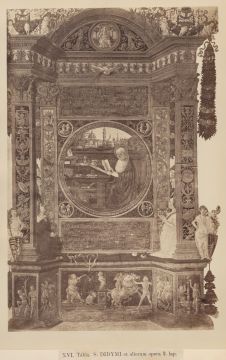
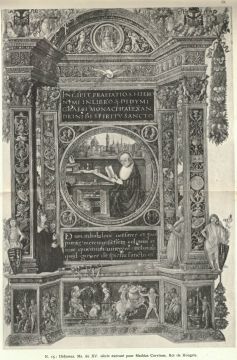
As mentioned already under J20 - Cicero Deorum, this MS was photographed at the Collegium Romanum by Flóris Rómer (see note 16). Thumbnails of three photos of the spectacular frontispiece of this MS are placed side by side below.
 |
 |
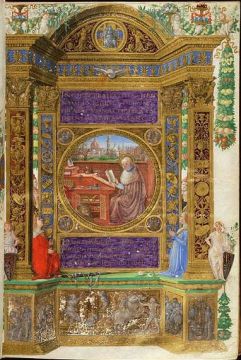 |
| Rómer (1871) | De Marinis (1913) | Morgan (modern) |
After Rómer's publication, this MS was considered to have the most lifelike illustrations of both king Mathias and queen Beatrice. Hungarian historians went on searches for this manuscript, but during this time the collection was in hiding in Castel Gandolfo, and all searches were in vain. One other manuscript photographed by Rómer had been moved to a Jesuit house in Vienna's 13th district (Lainz).
When De Marinis obtained these two manuscripts, he and his associate G. Forti immediately travelled to Budapest with a view to sell them, but the Hungarians were outbid by J.P.Morgan Sr., who acquired them through an intermediate dealer (A.Imbert of Rome). They have also become associated with the Jesuit house in Vienna-Lainz, but in reality they were never there.
The >>MS record
The >>De Marinis (1913) entry
The >>entry in De Ricci
This MS is identified in APUG 3289 (original text) as:
Hieronymus (S) / de gestis Patrum ad severi sulpicii de miraculis sanet P.P. cd. membr. s. XIV
Marginal note:
Census p. 1473
In Ruys.59:
p. 1473 (Ibid., Ms. 626);
De Ricci t.2, p.1473 (the Pierpont Morgan Library), nr. 626 says:
626. S.Hieronymus, Vitae Patrum. Vel (early XIVth c.), 138 ff. (35 x 25 cm.), imperfect at end, ff. 137-138 in a later hand. Written, according to B. Berenson, at Naples. 264 oblong miniat. In the lower margins. Modern red velvet.
Probably from the Collegio Romano, Rome - Obtained from W.M. Voynich. - cf. X…, Bull.Art Inst.Chic. IX (1915) p.100. B. Berenson, Studies in medieval painting (1930), p.115, note, fig 111; Exhib. Of illum. Mss. (1934), p. 44, n. 90, pl. 72; Expos. De l’art italien (Paris, 1935), pp. 483-484. n. 2305.
This is one of five cases in De Ricci where a MS is traced back to the Collegium Romanum library. These five are collected in this table.
This MS was one of Voynich's most highly valued manuscripts from the Jesuit collection. It was on display at his earlier exhibitions in the USA, in particular in Chicago in 1915 (see note 14). It also appears several times in the correspondence between Belle Da Costa Greene and Bernhard Berenson, for which see also here, under "Part 2". Voynich tried to sell it for $150,000 , which was not considered acceptable, and settled for half that price, which is still several million dollars in today's terms.
Berenson's assessment of the artwork, as referred to in De Ricci above, only tells us that he considers it to be from Naples, but does not lead to any additional information about this MS.
The >>MS record
The >>entry in APUG 3289 (†)
I have not yet been able to locate the De Ricci entry for this MS.
The original bibliographical slip of the MS is preserved in the Beinecke library, and says:
Isidori Originum liber V. Roderici toletani de rebus Hispaniae, a chart.9 ad 75.
[many details skipped]
Codex membranae in fol. Ms. saecul. XIV. Cum imaginis pictis in aliquot initialibus. Mutilus in fine. Constat foliis scriptis 178 (Ex Biblioteca Mureti).
Anne Nill's annotations:
In Huntington Library, see Census of MSS p.82
This MS is identified in APUG 3289 (original text) as:
Isidorus / Originum libri V Adduntur Roderici Toletano - Varia Hugonis Card. De ordine missae Martini Poloni - Chronica Hist.ae Variae cd. membr. saec. XIV
Marginal note:
Census p.82
In Ruys.59:
p. 82 (Ibid., Ms. HM 1034);
De Ricci t.1, p.82 (Huntington Library) nr. 1034 says:
HM 1034. Spanish chronicles, in Latin : S. Isidorus Hispalensis, Origines, liber V (ff.1 r. – 3 v.); Rodericus Toletanus, historia Gothica, 1274 (ff.3 v. – 97 r.); Hugo de S. Caro, De ordine missae (ff. 97r – 97 v.); Martinus Polonus, Historia Romanorum Pontificum ad annum 1277 (f. 97v. – 145r.); Historia Apolllonii regis Tyri (ff. 145r. – 152v.); Dares Phrygius, Historia Troianorum (ff. 152vv.-158v.); Saba Malaspina, Historia de iis quae contigerunt in Sicilia tempore regis Caroli (ff. 159r.-178v.), imperfect at end. Vel. (XIV c.), 178 ff. (40 x 29 cm.). Written in Spain. Many miniat. in initials Modern red velvet.
From a XIXth c. French coll.; obtained (Feb. 1918) from H.V. Jones, Minneapolis..
This MS is described in detail in the Huntington Library MS catalogue by C. Dutschke (see note 9), under HM 1034. This description is also available >>online here.
The >>MS record
The >>bibliographical paper slip entry (†)
The >>entry in APUG 3289 (†)
The >>entry in De Ricci
The original bibliographical slip of the MS is preserved in the Beinecke library, and says:
S. Isidori sententiarum libri
Codex membranac. in fol. Ms. Saec. XIII elegantissimus. Constat foliis scriptis 87.
Anne Nill's annotations:
in Free library (John F. Lewis coll.)
See Census of Mss., II. p.2047
This MS is identified in APUG 3289 (original text) as:
Isidorus (S) / Sententiarum libri cod.membr.saec. XIII
Marginal note:
Census p.2047
In Ruys.59:
p. 2047 (The free Library of Philadelphia, The John Frederick Lewis collection, Ms. 125);
De Ricci t.2, p.2047 (the Free Library of Philadelphia), nr. 125 says:
125. Isidorus Hispalensis, Sententiae. Vel. (XIth c.), 87 ff. (28 x 20 cm.). Written in Italy (or Spain?), Illum. initials. XVIIIth c. (?) vellum binding.
Obtained from Voynich (1915). – On the verso of the last f., in a XIIth c. hand, the prologue of S. Hieronymus on Job. On the recto, some accounts in Italian (XIIth c.?), including such items as in legname da collonne, etc.
Also this MS was on display at Voynich's earlier exhibitions in the USA, in particular in Chicago in 1915 (see note 14). The MS is presently preserved in the Free Library of Philadelphia as MS Lewis E 136. A full digital copy is available through the Digital Scriptiorium.
The Free Library catalogue entry for this MS quotes as seller: Arno M. Voynich, which I presume is a mis-reading of a pencilled note on the inside cover, which probably says: "Mr W. Voynich".
The >>MS record
The >>bibliographical paper slip entry (†)
The >>entry in APUG 3289 (†)
The >>entry in De Ricci
This MS is identified in APUG 3289 (original text) as:
Joannes Chrysost S. / Commentaria Graeca in Acta Apost. c. m. s. XI
Marginal note:
Census 1105
In Ruys.59:
p.1105 (The Library of the Univ. of Michigan, Ann Arbor, Mich., Ms. 14; v. M. M. Parvis et A.P. Wikgren, New Testament Manuscript Studies, Chicago, 1950, pp. 126 et 135);
De Ricci t.2, p.1105 (Library of the University of Michigan), nr. 14 says:
14. St. John Chrysostom, Homilies on the Acts of the Apostles, in Greek. Vel. (XIIth c.), 424 ff. (38 x 26 cm.). Old wooden boards and brown leather.
Obtained from W.M.Voynich (May 1922).
The reference to Parvis and Wikgren (18) refers to the contribution by Parvis: The importance of the Michigan manuscript collection for New Testament textual studies, pp.125-136. The relevant part is on p.126:
The real beginning of the Michigan New Testament manuscript collection, however, was made late in 1921 or early in 1922. At the time W.M. Voynich brought to the attention of Professor Kelsey a twelfth century manuscript of Chrisostom's homilies on the Acts of the Apostles. Professor Kelsey, Professor Sanders and Mr. Bishop (19) were immediately agreed upon the disirability of obtaining the codex for their collection. But the price asked by Voynich, a sum of nearly three thousand dollars, was more than the University was willing to pay. Accordingly, Professor Kelsey, armed wit the manuscript, journied to Detroit to plead his case before Horace H. Rackham. When Kelsey returned to Ann Arbor, he had, not three thousand, but fifteen thousand dollars to be used for manuscripts. The purchase of Chrysostom's homilies was completed in May, 1922.
The MS is presently in the Special Collections Research Center of the University of Michigan, shelf mark: Mich.MS.14. The Special Collections Research Center is located in the Hatcher Library of U.Mich. This is the only known Greek MS from this collection obtained by Voynich. The Vatican library obtained 50.
The >>MS record
The >>entry in APUG 3289 (†)
The >>entry in De Ricci
The following SDBM entry appears to refer to the same MS, but this remains to be confirmed:
>>Voynich catalogue entry
This MS is identified in APUG 3289 (original text) as:
Justinianus / Diversae Constitutiones cod. Membran. Saec XV
Marginal note:
Census 585
In the left margin there is also an older shelf mark: 4 D 20 ?
In Ruys.59:
p. 585 ([The library of the University of Chicago, Illinois], Ms. 423);
De Ricci t.1, p.585 (The University of Chicago), nr. 423 says:
423. (K.C. 817.N = 682746). Justinianus, Novellae Constitutiones. Vel. (early XIVth c.), 150 ff. (43 x 26 cm.). Written in Italy (doubtless at Bologna). Illum. initials. English Russia leather, ca. 1850, with sunken centers.
Obtained from W.M. Voynich (given in 1923 by alumni of the University).
The >>MS record
The >>entry in APUG 3289 (†)
The >>entry in De Ricci
The original bibliographical slip of the MS is preserved in the Beinecke library, and says:
Manetti Jannotii, De dignitate et excellentia hominis.
Congratulation ad Alphonsum Aragoniae Regem in Federici III Imperatoris visitatione ex Roma Napoli per eum facta.
Codex membranae in fol.p. Ms. Saec. XV cum ornatu depicto et stemmate in gratilinio[?] in 1a pagina, cumque initialibus librorum et titulis aureis. Constat foliis scriptis 120.
Anne Nill's annotations:
Not in Census of Mss)
De Marinis Cat.(1913) n.23
Arms of Alphonso of Aragon, King of Naples.
Bound in Vellum
This MS is identified in APUG 3289 (original text) as:
Jannotius Manettius / Varia cd. membr. Saec. XV
Marginal note:
x
In Ruys.59:
[T. De Marinis, La biblioteca napoletana dei re d'Aragona, t. 2, Milano, 1947,]p. 105 (Iannotii Manetti De dignitate et excellentia hominis; Florentiae, Raccolta Principe Piero Ginori Conti; = Manuscrits ... no. 23);
This MS does not seem to appear in De Ricci.
This MS is one of seven manuscripts that appear in De Marinis (1913), and which were evidently passed on to De Marinis after Voynich acquired them. The details of these seven manuscripts are summarised here.
MS is also described in De Marinis (1947) (see note 6), on p.105. Here, De Marinis argues that the MS came from the library of Cardinal Henry Benedict Stuart, which is certainly not correct, and is probably what Voynich told him, in order to avoid naming the true origin of the MS. He also explains that the MS was later offered for sale by U. Hoepli of Milan.
Several later owners are known. The latest sales record is a Sotheby sales catalogue of 1974 (see note 13), (see also SDBM entries below). The following owners after De Marinis are listed in the SDBM record:
Charles Harry St. John Hornby (1867-1946);
Major J.R. Abbey (1894-1969);
This MS appears to have changed hands together with J06 - Ausonius from the library of Alfonsus until at least 1974. The present owner of this MS is not yet known to me.
The >>MS record
The >>bibliographical paper slip entry (†)
The >>entry in APUG 3289 (†)
The >>De Marinis (1913) entry
The >>entry for the 1974 Sotheby sales catalogue
The original bibliographical slip of the MS is preserved in the Beinecke library, and says:
Ioannis Baptistae Mantuani Carmelit. Partenice sive de laudibus B.M.V. Carmen
Codex membranac.in 4o. Ms.saec.XV. cum imaginibus eleganter depictis et stemmate gentilicio in 1o.pag. Constat foliis scriptis 69.
Anne Nill's annotations:
Not in Census of Mss.
This MS is identified in APUG 3289 (original text) as:
Mantuanus J.B. / Parthenice sive de laud. B.V. cod. membr. saec. XV
Marginal note:
x
It is not mentioned in Ruys.59.
This MS is not listed in De Ricci.
Neither Anne Nill nor Mgr Ruysschaert were able to find out what happened with this MS, but this was finally discovered by Hungarian researcher A. Pócs, and presented in a paper published in 2017 (see note 17). This MS is now preserved in Budapest in the National Széchényi Library, as Cod.Lat.445. It was purchased in Paris in 1912 by Hungarian book dealer Lajos Ernst. Pócs considers that it was purchased from De Marinis, but this seems unlikely (20), as it does not appear in the same catalogue as the other volumes from the Collegium Romanum, and De Marinis did not have any presence in Paris.
This MS shows traces of burning, which is connected with a fire in the Collegium Romanum building, also affecting the library, which took place in 1849. Another interesting fact uncovered by Pócs is that one bifolio of the Mantuanus MS ended up being bound into a Juvenalis MS (Vat.Lat.11477), for which see Ruysschaert (1959) p.112 (see note 5).
The >>MS record (†)
The >>bibliographical paper slip entry (†)
The >>entry in APUG 3289 (†)
The original bibliographical paper slip of this MS has not survived.
This is also one of only three manuscripts that cannot be identified in APUG 3289. Of these three, J22 - Didymus and J30 - Marcanova are definitely missing. The third: J05 - Aristoteles, is perhaps the result of a confusion by Ruysschaert, but this remains to be resolved.
Even though the MS was not listed in APUG 3289, Ruysschaert found out about it, and recorded it in Ruys.59 as follows:
p. 897 (Ibid., Ms. 158; olim Marci Antonii Muret);
De Ricci t.1, p.897 (Library of Robert Garrett) nr. 158 says:
158. Giovanni Marcanova, Antiquitates, including many copies of ancient inscriptions, and fantastic views of the classical monuments of Rome, Vel.(ca. 1460?), 209 ff. (36 x 26 cm). XVIIIth c. Italian vellum binding.
Belonged to Muretus and preserved until 1870 in the Collegio Romano, at Rome; obtained from W.M. Voynich (1924). – Apparently a copy of the similar ms. At Paris (Bibl. Nat., Lat. 5825 F) – On the Garrett ms., cf. Th.Mommsen, Corp. inscr. lat., III (1873), p. XXIX; Holmes Van Mater Dennis, 3rd, The Garrett manuscript of Marcanova, in Memoirs of the American Academy in Rome, VI (1926), pp.113-126; Elizabeth Baily Lawrence, The illustrations of the Garrett and Modena manuscripts of Marcanova, ibid., pp.127-131 and pl. 23-48 ; cf. also an unsigned article, The Voynich collection in Bull. Art Inst. Chicago, IX (1915), p.100.
This is one of five cases in De Ricci where a MS is traced back to the Collegium Romanum library. These five are collected in this table.
Voynich had high hopes for this MS, which he referred to as his 'Finiguerra', and which he tried to sell for $150,000 already in 1913. For these events see the summary of the Belle Da Costa Greene correspondence on this page (under "Part 2").
Also this MS was on display at his earlier exhibitions in the USA, in particular in Chicago in 1915 (see note 14).
It was sold much later to Robert Garrett. The latter had a thorough study done of this MS (21), which led to the firm conclusion that this MS was originally in the Collegium Romanum library, where it had been seen and described by various people. It was identified as being from the library of Antonius Muretus (22).
The >>MS record
The >>entry in De Ricci
This MS is tentatively identified in APUG 3289 (original text) as:
Miscellanea / c. m. s. XV
Marginal note:
Census 1846 [overwriting a captial V]
In Ruys.59:
p. 1846 (Ibid., Ms. 8);
De Ricci t.2, p.1846 (the estate of W.Voynich) nr.8 has a very long description of the MS and its history as known and suspected at that time. The most relevant part of it is included here:
8. Cipher ms. Vel. (date uncertain, authorities hesitate between the XIIIth and XVth c.; we suppose it to be not much older than 1500), 91 ff. [...] numbered in a XVIth century hand from 1 to 116, with a few gaps. Numerous drawings on 202 pages, botanical, pharmaceutical and astrological. The country of origin seems to be some part of Central Europe. The language and script have baffled numerous attempts towards a decipherment. Limp vellum wrapper, apparently of the XVIth century. Paper end-leaves possibly of the same date.
Attached to the binding is an autograph letter (Prag, 19 Aug.1665 [or 1666]) from Marcus Marci, of Cronland, to the Jesuit Athanasius Kircher [...]. It was later in the Collegio Romano, in Rome, and was obtained in 1912 by W.M. Voynich. [...]
This is one of five cases in De Ricci where a MS is traced back to the Collegium Romanum library. These five are collected in this table.
The >>MS record
The >>entry in APUG 3289,
listed as 'possible' (†)
The >>entry in De Ricci
This MS is identified in APUG 3289 (original text) as:
Ptolemaeus / Almagestum cd mem s. XIV
Marginal note:
Census p.49 HM 65
In Ruys.59:
p. 49 (The Henry E. Huntington Library, San Marino, California, Ms. HM 65);
De Ricci t.1, p.49 (the Huntington Library) nr 65. says:
HM 65. Ptolemaeus, Almagestum, translated into Latin by Gerardus Cremonensis. Vel. (1279, date on f. 184 r.), 270 ff. (31 x 21 cm.). Written in France. Illum. Initials. XVIIth c. vellum wrapper.
Erased inscription at top of first page. – From the coll. Of the Rev. Frank W. Gunsaulus.
This is one of the manuscripts that used to be in the library of De Leoni, private physician of Lorenzo de Medici. This collection has been described in Ruysschaert (1960) (see note 8).
This MS is described in detail in the Huntington Library MS catalogue by C. Dutschke (see note 9), under HM 65. This description is also available >>online here.
The >>MS record
The >>entry in APUG 3289 (†)
The >>entry in De Ricci
This MS is identified in APUG 3289 (original text) as:
Ritius Michaelis / de regibus Gall. et. cod. ch. XVI s.
Marginal note:
[Erased pencilled text]
It is not mentioned in Ruys.59.
This is perhaps a spurious record in APUG 3289, or, to be more precise, a duplication of an earlier record. On the page with authors whose names start with "R", it is the fourth entry, and the first in a new hand. Its wording is identical to the first entry on that page. As a paper MS from the 16th century, it would not have appealed much to Voynich.
The original bibliographical slip of the MS is preserved in the Beinecke library, and says:
Rufini presbyteri Periarchon Origenis libri IV e graeco in latinum translati. S.Pamphili Martyris Apologeticus pro libris Origenis. Rufini Additio pro defensione Originis
Codex membranac. in fol. Ms. saec. XV cum stemmate in 1a. pag.a et cum initialibus auris varie ornatis. Constat foliis scriptis 173.
Anne Nill's annotations:
Now in Art Institute of Chicago.
See Census of Mss. I, p. 516.
This MS is identified in APUG 3289 (original text) as:
Rufinus praesbiterium / Periarchon Origenis ad. Pamphilius S. Mart. Apologeticus pro libris Origenis Rufini additio pro defensione Origenis c. m. s. XV
Marginal note:
Census p.516
In Ruys.59:
p. 516 (The Art Institute, Chicago, Illinois, Ms. 20. 97);
De Ricci t.1, p.516 (The Art Institute, Chicago), nr. 20.97 says:
20.97. Origenes, Periarchon, translated from Greek into Latin by Rufinus, followed by the apology of Pamphilius for Origenes. Vel. (ca 1480), 174 ff. (32 x 22 cm.). Written in Italy (doubtless at Florence). Illum. Initials in the manner of Francesco d’Antonio del Chierico. XVIIth c. Italian vellum wrapper.
Arms of first owner (per fesse indented gules and argent; on a chief azure a mouse (?) standing upon a wheatstalk fesseways). – Obtained from W.M. Voynich by Rev. Frank W. Gunsaulus, who gave it to the Museum in 1920. – The opening page is reproduced in colors in Bull. Art Inst. Chicago, XIV (1920), p. 105, cf. p.111.
The >>MS record
The >>bibliographical paper slip entry (†)
The >>entry in APUG 3289 (†)
The >>entry in De Ricci
The original bibliographical slip of the MS is preserved in the Beinecke library, and says:
Valerii Maximi, dictorum et factorum memorabilium, libri novem
Codex membranaceus in fol. Ms.saec.XIV; attamen ? penult. Capitis 1. lib. V ac deinceps est alterius manus, saeculi XV, ut videtur. Constat foliis scriptis 126.
Anne Nill's annotations:
Now in U. of Michigan
See Census of mss. II p.1120
This MS is identified in APUG 3289 (original text) as:
Id. [Valerius Max.] / Id. [Factor. et dictor memor. libri IX] cd.membr.saec. XIV
Marginal note:
[blank]
It is not mentioned in Ruys.59.
Whereas Anne Nill identified this MS in De Ricci, Ruysschaert did not, and he did not add it to the footnote in his 1959 catalogue. The De Ricci entry says:
148. Valerius Maximus, Facta et dicta memorabilia. Vel. (ca 1400), 126 ff. (27 x 20 cm.). Written in Italy. Diagrams and illum. initials, the first of the latter containing a view of Rome. XVIIth c. Italian binding.
Obtained from W.M. Voynich (Feb 1925).
The MS is presently in the Special Collections Research Center of the University of Michigan, shelf mark: Mich.MS.148. The Special Collections Research Center is located in the Hatcher Library of U.Mich.
The MS is briefly described on >>this web page of the University of Michigan, in the scroll box, where the reader needs to scroll down to near the bottom. This also shows a colour image of the opening folio with an illumination showing the city of Rome. The MS is further described in detail Kelsey (1925) (23), with emphasis on the opening illumination.
It is worth noting that the publication by Kelsey describes in detail how the MS has been written in two hands, the first late 14th century and the second part early 15th century. This is identical with the description on the bibliographical paper slip from the Jesuits shown above, which was not available to Kelsey's source at the time.
The >>MS record
The >>bibliographical paper slip entry (†)
The >>entry in APUG 3289 (†)
The >>entry in De Ricci
The following SDBM entry appears to refer to the same MS, but this remains to be confirmed:
>>Voynich catalogue entry
This MS is identified in APUG 3289 (original text) as:
Valtorii / Rerum militarum lib. XII c. char. sec. inc.
Marginal note:
Census p.1848
In Ruys.59:
[The estate of Wilfrid M. Voynich, New York, ] p. 1848 (Ibid., Ms. 13 aut Ms. 14; nunc vide The Rosenwald Collection (The Library of Congress), Washington), 1954, p.2, Ms. 5 aut Ms 6);
Ruysschaert could not decide which of two Valturius manuscripts in Voynich's estate matched the entry in APUG 3289. Both are listed in De Ricci t.2 p.1848, entries 13 and 14. We may call the former: J36a and the latter J36b.
We know from Kraus' autobiography (24), chapter 14, that he (Kraus) sold two MS copies of Valturius 'De Re Militari' to Rosenwald, who later donated them to Library of Congress, as Ruysschaert also states.
Voynich MS 13 is described in De Ricci as:
13. Robertus Valturius, De Re Militari, Pap. (XVth c.), 197 ff. (32x22 cm.). Written in Italy. 13 large illum. initials. Military drawings on 85 pages. Old vellum binding.
V.H. 7 in an old library; early instriptions: Episcopi Antonii Politiani (?); arms on f. 4 r. (azure a tower argent, a very common bearing) with the letter R on the left.
This MS can be positively identified with Library of Congress MS Rosenwald 6, which has 182+ ff. and is 34 cm high. In Rosenwald's library it used to be Rosenwald MS 14. LoC provides full digital access to this MS via >>this link.
The MS has severe water damage at the top of its pages. The "V.H.7" entry is found on the first written folio (image 15 of the digital) scan. The arms are on fol.4 (image 21).
Voynich MS 14 is described in De Ricci as:
14. Robertus Valturius, De re militari. Pap (XVth c.), 208 ff. (28x21 cm.), of which ff. 1-4, 15,26,160 and 169 are vellum. Written in northern Italy. Drawings on 88 pages. XVIIIth c. calf.
Contains the S.I. impresa of Sigismondo Malatesta (also his rose quarrefoil) on the shield of an armed knight. There are notable variations from the printed editions and from other mss.
This MS can be positively identified with Library of Congress MS Rosenwald 7, which has 208 ff. and is 30 cm high. In Rosenwald's library it used to be Rosenwald MS 13. LoC provides full digital access to this MS via >>this link.
This MS has the mysterious drawing of a young man, which Voynich attributed to Mantegna, on a leaf of slightly different size, as image 356 of the digital scan. This is also the MS that was on exhibition in Chicago in 1915 (see note 14).
The arms of Malatesta are found on fol. 160r., image 337 of the digital scan.
While ELV and Anne Nill were still running the book business in New York, but with great trouble, their main hope was to obtain a good sale for one of the two remaining valuable books. These two were the cipher MS and a Valturius. That Valturius was undoubtedly J37b, with its 'Mantegna' and its text variations.
There are almost no details that can help us to resolve this issue. The APUG catalogue just says that the MS is on paper. J36a is fully on paper and J36b has a few parchment folios among a mostly paper MS. This does not help us. The date of the MS in APUG 3289 is given as 'uncertain'. Both manuscripts are described in De Ricci as 15th century, so also this does not help us.
The binding might tell us something. The present bindings in LoC are modern, and clearly replace the ones described in De Ricci. These say: "old vellum binding" for J36a and "XVIII century calf" for J36b. The latter is slightly more likely, but this cannot be considered conclusive.
J36b is undoubtedly the more valuable of the two, but we may not assume that this is therefore also the one that came from the Collegium Romanum.
Remaining possibilities are to find more provenance information about the 'non-Jesuit' Valturius, or to find provenance details in the manuscripts themselves.
While there is a small preference for J36b, it needs to be considered 'undecided' for the time being.
Due to the above-mentioned uncertainty, the entry in APUG 3289 has not been linked to either MS in the SDBM.
The >>MS record for J36a
The >>MS record for J36b
The >>entry in De Ricci for J36a
The >>entry in De Ricci for J36b
This MS is identified in APUG 3289 (original text) as:
" [Virgilius P.M.] / Opera c. membr. s. XV
Marginal note:
Census p. 886?
p. 1896?
In Ruys.59:
p. 886 (The Library of Robert Garrett, Baltimore, Maryland, Ms. 110) aut p. 1896 (Ms. 36; v. infra);
p. 1896 ([The Library of Grenville Kane, Tuxedo Park, N.Y.] Ms 36) aut p. 886, Ms 110 (v supra);
Ruysschaert could not decide which of two manuscripts was the correct one. In the following, we
may call the two options J37a and J37b respectively.
J37a corresponds with De Ricci t.2, p. 1896, nr. 110, which is Garrett MS 110.
This is presently in the Princeton library.
J37b corresponds with De Ricci t.1, p. 886, nr. 36 which is Kane MS 36.
At present this is equally in the Princeton library.
Both manuscripts are described in great detail in the The Princeton MS catalogue by Don Skemer (see note 7). For MS Garrett 110 (vol.1 pp.243-246) it is stated that the MS used to be in the Collegium Romanum. On the one hand it refers to Ruysschaert and De Ricci for this, which we saw above are not conclusive. A similar statement is also found in its description of Kane MS 36 (vol.2 pp. 81-84).
More conclusively, Skemer notes that the Garrett MS has ownership notes from a certain Cardinal Valerius Miccus on two of its pages. He also refers to a publication by Giuseppe Bartoli (25), writing about Virgil's Eclogues, which states on p.63 that the library of the Collegium Romanum had a parchment MS in folio that was once owned by Valerius Miccus. In fact, this publication is online, and the MS is described as un codiceo membranaceo in foglio piccolo. It is used by the author because it confirms a text variation ("Qui") as follows:
[...] e nella postilla interlineare conferma questa lezione.
This means that the Garrett MS is undoubtedly the correct match. This could be further confirmed by checking the text of the above-mentioned passage in the MS.
This also makes this one of the few manuscripts for which we have a reference while it was still in the Collegium Romanum library.
The >>MS record for Garrett MS 110
The >>entry in APUG 3289 (†)
The >>entry in De Ricci
An >>exhibition catalogue describing Garrett MS 110
The >>Sotheby catalogue of 1921,
listing a price of $1600 for this MS.
This MS is identified in APUG 3289 (original text) as:
Id. [Virgilius P.M.] / Bucolicon, Georgicon et Aeneis cd. mem s. XV
Marginal note:
Census p.2057
In Ruys.59:
p. 2057 [The free Library of Philadelphia, The John Frederick Lewis collection], Ms. 172; olim Marci Antonii Muret, v. infra p.23);
De Ricci t.2, p.2057 (The free library of Philadelphia) nr. 172 says:
172. Vergilius, Aeneis, Bucolica, Georgica. Vel. (ca 1450),
[...]
N. 541 in an old Italian library. Owned (ca. 1800?) by Antonio Caboge of Ragusa. - Given (ca 1915?) by W.M. Voynich.
This MS has been renamed/renumbered in the Free Library as MS E 198. Some digital images are online, including the Ex Libris of Antonio Caboge (for which see the main page). While the inconsistent order of the books in the MS could lead to some doubt, the fact that this MS was in the library of Antonio Caboge of Ragusa should remove such doubt. Several other manuscripts from his library have been preserved in the Vat.Lat. collection (for which see also the main page).
The >>MS record for this MS (which does
not give the modern shelf mark).
The >>entry in APUG 3289 (†)
The >>entry in De Ricci
Following are the most important sources for the present descriptions. For some of the manuscripts, additional sources like auction catalogues exist.
The following table lists the 16 bibliographical paper slips that are still preserved in the Beinecke Library. A remark by Hans P. Kraus suggests that at some earlier time, while he still owned the Voynich MS, there may have been 17 (to be added). In addition, one paper slip was seen and transcribed in 1870, namely that of J22 - Didymus, for which see.
| ID | DM13 Nr | APUG 3289 | De Ricci | SDBM |
|---|---|---|---|---|
| J01 - Aelianus | 2 | Yes | - | >>MS |
| J02 - Alfraganus | - | Yes | t.1 p.1845 nr.1 (possibly) | >>Cat |
| J05 - Aristoteles | - | Possibly | J05a: t.1 p.700 nr.8 J05b: t.1 p.512 nr.3 J05c: t.1 p.82 nr.1035 |
>>MS |
| J06 - Ausonius | 6 | Yes | - | >>MS |
| J08 - Biblia | - | Yes | Unknown | - |
| J14 - Boccaccio | - | Yes | t.1 p.564 nr.100 | >>MS |
| J15 - Breviarum | - | Yes | Unknown | - |
| J17 - Candidus | 14 | Yes | t.1 p.961 nr.23 | >>MS |
| J20 - Cic.Deorum | 10 | Yes | t.2 p.1461-2 nr.497 | >>MS |
| J21 - De Leoni | - | Yes | t.2 p.1848 nr.16 | >>MS |
| J24 - Idis.Originum | - | Yes | t.1 p.82 nr.1034 | >>MS |
| J25 - Isid.Sententiae | - | Yes | t.2 p.2047 nr.125 | >>MS |
| J28 - Manetti | 23 | Yes | - | >>MS |
| J29 - Mantuanus | - | Yes | - | - |
| J34 - Rufinus | - | Yes | t.1 p.516 nr.20.97 | >>MS |
| J35 - Valerius | - | Yes | t.2 p.1120 nr.148 | >>MS |
While Voynich was obliged to keep the origin of his manuscripts a secret, this origin: the Collegium Romanum library of the Society of Jesus in Rome, was gradually discovered by several people and institutes over time. Already in De Ricci's census, which appeared in 1935 and 1937, this is recorded for the following five manuscripts:
| ID | De Ricci | Part of description |
|---|---|---|
| J14 - Boccaccio | t.1 p.564 nr.100 | belonged to the Jesuits of the Collegio Romano, Rome |
| J22 - Didymus | t.2 p.1461 nr.496 | long preserved in the Collegio Romano, Rome |
| J23 - Hieronymus | t.2 p.1473 nr.626 | Probably from the Collegio Romano, Rome |
| J30 - Marcanova | t.1 p.897 nr.158 | Belonged to Muretus and preserved until 1870 in the Collegio Romano, at Rome |
| J31 - Misc./Voynich MS | t.2 p.1846 nr.8 | It was later in the Collegio Romano, in Rome |
For five of the seven manuscripts listed below, the bibliographical paper slip was kept by Voynich and has been preserved to this day, which demonstrates that De Marinis obtained these manuscripts from Voynich and offered them for sale. Three of these appear in his later 1947 publication about the library of Alfonso of Aragon, and for two of these three ( J01 and J06 ) he writes specifically that he obtained these manuscripts from Voynich.
| ID | DM13 Nr | Bibl.slip | APUG 3289 | In DM47 | SDBM MS | SDBM DM13 |
|---|---|---|---|---|---|---|
| J01 - Aelianus | 2 | Yes | Yes | pp. 3-5 | >>MS | >>Cat entry |
| J04 - Anon Constit. | 11 | No | Yes | - | - | >>Cat entry |
| J06 - Ausonius | 6 | Yes | Yes | pp. 22-23, plate 27 | >>MS | >>Cat entry |
| J17 - Candidus | 14 | Yes | Yes | - | >>MS | >>Cat entry |
| J20 - Cic.Deorum | 10 | Yes | Yes | - | >>MS | >>Cat entry |
| J22 - Didymus | 15 | No | No | - | >>MS | >>Cat entry |
| J28 - Manetti | 23 | Yes | Yes | p. 105 | >>MS | >>Cat entry |
The information contained in this page has been collected over a span of more than 15 years. It remains relatively incomplete, mainly because of limited access to library and catalogue resources through the internet. Still, that situation has improved spectacularly over recent years.
It is important to keep in mind that some MS identifications by Ruysschaert may have been 'best guesses'. Anne Nill would have had more relevant information from Voynich's sales records, but hers has been recorded for only a subset of the manuscripts.
Numerous printed and online descriptions of the manuscripts listed on this page do not mention that the MS used to be in the Jesuit Collegium Romanum in Rome. This may be because that information is not yet available to them, or it was not when the record was created.
|
|
|
|
|