



|
|
|
|
|
The main page related to the illustrations in the MS is here. The present page has the following topics:
For a long time, no fundamental difference has been observed between the drawings styles on the herbal pages of the MS, whereas both the handwriting and the textual statistics clealy subdivide these pages into two groups. This changed in 2024 when Koen Gheuens and Cary Rapaport together performed a detailed study of these illustrations.
These two sets of pages are usually refered to as Herbal-A and Herbal-B, after the Currier language used on these pages.
They came up with a set of criteria that allow to determine in the great majority of cases whether a plant drawing belongs to a Herbal-A or a Herbal-B page. They also used the letters A and B for these criteria. Here, I will use the Greek letters α and β instead, to avoid confusion in cases there is not a match. The means that when a page is called an A-page or a B-page, this refers to the Currier language only, not to the drawing style.
The purpose of the present discussion is only to summarise their work. The full discussion may be found in the >>blog of Koen Gheuens (1).
Such a line must be drawn in ink. If it is drawn in paint, it does not count. In some cases the line is double.
These flowers may show several layers of petals, and you will not see the centre of the flower. Again there are no exceptions: this α-feature is not found on B-pages.
This shape consists of a bulbous bottom and three sepals (spiky leaves surrounding the petals of the flower).
These must consist of solid lines, not dotted lines, which also appear on B-apges.
It does not connect to the edge or an end of the leaf.
These must be significant differences, not small variations. Usually, one of the leaf shapes is much smaller than the other.
The only exceptions, namely α-plant features on B-pages, are, in order of the listed features:
This most obvious of all β-features means that there is a usually small round flower that almost looks like an addition to the plant. It has a round centre with dots, and small petals along the entire perimeter.
These are very distinct from the earlier α-type calyxes.
Not meant is real grass, but lines that look like grass or hair.
These should be distinguished from 'flat root tops' (an α-feature), in the sense that they appear to represent a patch of terrain that was cut out.
This requires no special explanation.
The leaflets are like fingers that all point in the same direction.
There are three exceptions, namely β-plant features on A-pages, all concerning the feature: 'broad many-fingered calyxes'.

In the past, the blog of Ellie Velinska included some highly interesting comparisons between the Voynich MS and other historical items, for example in other manuscripts. She unfortunately decided to discontinue her association with the MS, and deleted her blog. One of the few items that may have gone forgotten, and appears worthy to remind people of, is her comparison of Voynich MS f69r and a winds diagram in an Oxford manuscript. It has been included below.
This MS dates from the early 12th century, and deals with the cosmology of Isidore of Seville. One of its most conspicuous illustrations is what is usually referred to as the Byrhtferth diagram, which is found on fol. 7v (2). This has its own interesting aspect for the Voynich MS, as it is one of the few known examples where the zodiac signs are associated with the months in which the Sun leaves each sign, as is apparently also the case for the Voynich MS.
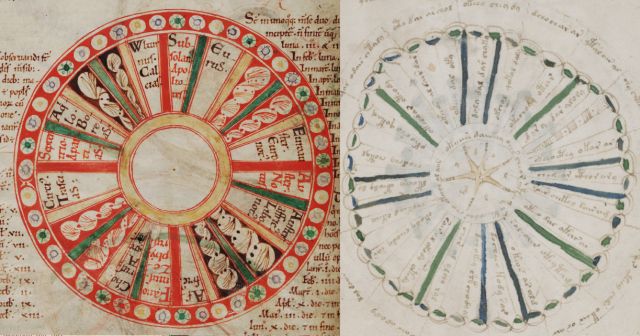
Here, we are not concerned with this diagram, but with a winds diagram found on f40v. The following three illustrations were retrieved from Ellie's blog and have only been reduced in size. The first shows the two complete diagrams side by side.
She added that she had counted the number of items on the outer circles: there are 46 in the St. Johns MS and 45 in the Voynich MS.
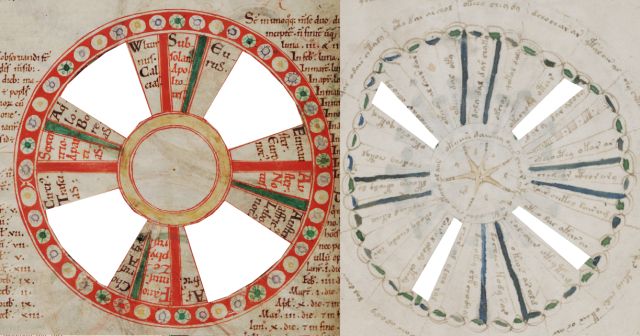
To highlight the similarity, two cut-outs had been prepared by Ellie. In the first we see the four cardinal directions each surrounded by a pair of lines.
The second highlights the intermediate directions, in both cases with green lines.
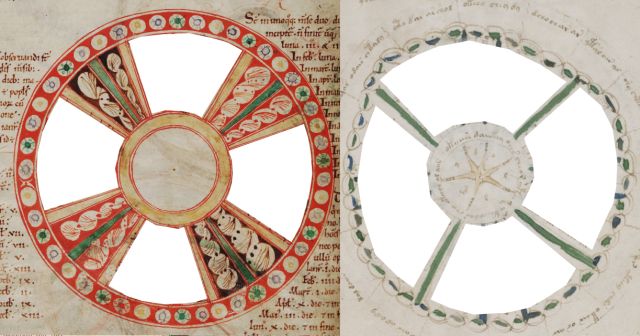
It is clear that there are also important differences, in particular related to the text. In the St.Johns' college MS the wind names are grouped around the cardinal directions, three at each, for a total of 12.
In the Voynich MS illustration, there are 22 text items inside the diagram. (There is more text outside it.)
|
|
|
|
|