






|
|
|
||
|
|
|
|
|
Following are biographies of a number of people related to the Voynich MS. These biographies are not intended to cover all aspects of their lives and careers, but emphasise areas for potential connections with the history of the Voynich MS. With the exception of Georgius Barschius, more complete biographical information may be found in printed literature. A portrait gallery including almost all of the people discussed in this page is available via this link. Footnotes are provided separately for each biography.
See note A.1. There exist three illustrations that are considered to have been drawn after his likeness. One is a woodcut on the cover of the Aigentliche Beschreibung der Raisz... (see note A.1). The other two are both on the frontispiece of his Vierte Kreuterbuch. On the left he is (presumably) seen as someone planting a herb. On the right he appears as a physician.
It is possible, but far from certain, that Rauwolf owned the Voynich MS before Karl Widemann. There are some considerations about this possibility in Guzy (2023) (A.2).
The present section is largely a placeholder, and the reader is advised to consult his published biography (see note A.1).
Rauwolf was a physician who had studied under Guillaume Rondelet at the University of Montpellier. He is best known for his travels to the near East, and for the Herbaria Viva he created, which include specimens from his travels. He sold these books to Rudolf II in 1593, on the recommendation of the famous botanist Carolus Clusius. They are listed in the inventory of Rudolf's Kunstkammer. They were taken to Stockholm during the looting of Prague by the Swedes. Queen Christina later donated them to Isaac Vossius and they are now preserved in Leiden (NL).
Rauwolf lived in Augsburg, where he was the city physician, but he was forced to leave in 1588. He went to Linz, but he retained his Augsburg citizenship and his house, which was located at Grottenau nr. 8 (A.3). His successor Karl Widemann lived there until Rauwolf's death in 1596 (see note A.2). It was during the time Rauwolf lived in Linz that he sold his Herbaria Viva to Rudolf.
After his death, in 1599, his library entered the Augsburg city library. Guzy considers (see note A.2) that Wideman may have obtained the Voynich MS from this library at that time, but there is no specific evidence for that.

See note B.1. No portrait of Widemann is known to exist.
Widemann's first name is variously given as Karl, Carl or Carolus, while his last name may be spelled Widemann, Wideman or Weidemann.
Karl Widemann was born in Munich on 2 August 1555 (B.2). His family decided to leave Munich due to religious issues, and they settled in Augsburg. Already at age 14 he went to the university of Ingolstadt, and at age 16 to the university of Leipzig. One year later he decided to go to Padua and this is where he obtained a non-standard doctorate from the hands of a nobleman. In order to be able to practice as a physician, he also went to the university of Dole, where he obtained a second doctorate. He still had trouble to be accepted as a physician in Augsburg, because there was no evidence that his second doctorate included medicine.
He married a daughter from the relatively weathly Zimmermann family. In 1587, probably through the help of his old college friend Gruber, who was working with Edward Kelly, he went to Třeboň (Wittingau) with his family, to work for Vilém of Rosenberg. During this time, he apparently also worked together with Edward Kelly. An autograph notebook of Wideman with reference to Kelly, containing alchemical recipes, has been preserved (B.3). Carlos Gilly quotes a letter in which he explains that Rudolf II gave or showed Widemann a steganographic manuscript "ad imitationem Trithemii". (B.4). Furthermore, Widemann appears to have said: "und dessen wegen ain geraume Zeit mich doselbsten aufghaldtten nitt mit geringen costen, versaumnus und verehrungen" (B.5). He left Rosenberg after one year, in the autumn of 1588. His farewell letter is still preserved (B.6).
After this, he became a medical doctor in Augsburg. Already since 1584 he was an eager collector of manuscripts, and this acativity picked up considerably in 1588. He obtained texts to be copied from many different contacts. He was mainly interested in Paracelsan and alchemical works, and his copies of many works of Paracelsus contributed greatly to the preservation of Paracelsus' writings. He was closely associated with the early Rosicrucians.
In March 1599 he sold several books to Rudolf II, for 500 Taler. This transaction very likely included the Voynich MS, which will be analysed in more detail below (B.7). This sale presumably also included some of his autograph copies of alchemical manuscripts. These cannot be found back in Rudolf's Kunstkammer. However, some of them are now preserved in Leiden (B.8), after they were taken to Stockholm as Swedish war booty, and later donated to Isaac Vossius by Queen Christina. These have leather covers and in some cases the insignia of Rudolf II (B.9).
In 1629, Widemann completed a catalogue of his library, including all works he had ever seen (to be confirmed). This catalogue is still preserved in Kassel (B.10).
The Austrian state Archive in Vienna still hosts court finance records (Hoffinanz) from all of Rudolf's reign, specifically complete lists of both incoming records/letters and outgoing records/letters. Significant parts of these have been transcribed, and are available online (B.11). Other transcribed parts have been printed (B.12). A detailed list of book transaction is presented in Guzy (2023).
There is a record of a sale of books from Widemann to Rudolf on 1 March 1599 for the amount of 500 Taler. This is close to the amount of 600 ducats that Marci mentioned in his letter. There are further interesting remarks related to this sale in entries from 1600. Their transcription and translation is provided here here, indicating that the book(s) in question was 'unusual'. It was acquired on behalf of Rudolf II by his accountant Zacharias Geizkofler, who took the book to Prag, where it was handed over to Rudof's chamberlain Hans Popp.
Additional records discovered by Stefan Guzy (see note B.1) in the Geizkofler archives in Ludwigsburg, Germany, demonstrate that the amount of money that Widemann received for these books was 600 Rheinische Gulden, i.e. 600 gold pieces.
See note C.1. The following portrait is from a painting by Hans von Aachen, made in the 1590's. It is presently in the Kunsthistorisches Museum, Vienna.
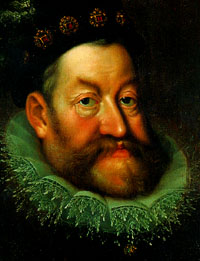
For Rudolf II a representative biography is completely outside the scope of these pages. Here, I will concentrate only on some aspects of his life, as far as they may be relevant for the Voynich MS.
Rudolf II was born in Vienna on 18 Juli 1552 as the son of Maximilian II and Maria, daughter of emperor Charles V. At the age of 11 he moved to the court of his uncle, King Philip II in Spain. He stayed in Spain from 1564 to 1571, and both the Spanish ceremony used at the court, and the art collections of Philip II made an everlasting impression on him. In 1572 Rudolf became the King of Hungary and in 1576 he was crowned king of Bohemia in the St. Vitus Cathedral in Prague. On 27 October of the same year he was crowned Holy Roman Emperor in the Cathedral of Regensburg (Ratisbona).
In 1578 he suffered a stomach ailment and this marked the start of his melancholic depressions. His first serious depression occurred in 1582. One year later he decided to make Prague his permanent residence, as it was better defended against the ever dooming danger of Turkish attacks.
Rudolf II had a long list of imperial physicians taking care of him over the several decades till his death. Jacobus de Tepenec, the next known owner of the Voynich MS, reputedly once cured him from a grave disease, and he is occasionally called one of his personal physicians, but he was not. Many of these physicians are treated in great detail in dedicated chapters in Purš and Karpenko (2016) (see note C.1).
Rudolf collected a large group of artists and scientists at his court. Wilfrid Voynich writes that he studied the lives of many of them in order to identify the one(s) most likely to have sold the Voynich MS to Rudolf. He concluded that John Dee was the one, however, this is no longer considered likely. Voynich based his opinion on a historical novel rather than serious studies of the court of Rudolf (C.2). In reality, the list of candidates is extremely long. Just to give a short impression of this, further below is a summary list of names (sorted alphabetically) of people who were related with the court of Rudolf II, and had something to do with books, alchemy, medicine, or botany (C.3). This list could be extended very signficantly.
In addition, the archival research of Stefan Guzy has resulted in a detailed list of book transactions of Rudolf II that have been recorded (C.4). The result of his work, which was initiated by myself, is that the most probable seller of the Voynich MS to Rudolf II is Karl Widemann.
Blotius, Hugo
Librarian, responsible for the Hofbibliothek in Vienna. See also Richterová (2016)
(C.5).
Boethius de Boodt, Anselmus
Alchemist and mineralogist, who reputedly owned some powder
that allowed the transmutation
(C.6).
Bruno, Giordano
Italian philosopher who was executed in Rome by burning at the stake, in 1600, because of his views which
conflicted with the church. He visited Prague in 1588 and received a few hundred silver Thaler from Rudolf
for a book dedicated to him.
de Busbecq, Ogier Ghislain
Busbecq was a person of very diverse talents. His letters include observations on plants, customs, religions,
languages, and much besides. He undertook all kinds of commissions for Rudolf in Paris,
from the recommending of personnel to dealing in clocks and Hermetic literature.
Rudolf was especially favourably disposed to him: Busbecq's letters to Prague from 1582 to 1586 demonstrate
their close contact, as well as being full of valuable information on the French scene.
He is famous among others for bringing the Juliana Anicia codex (Vienna Dioscorides) to Prague, and
introducing the tulip into Europe (both before Rudolf's time).
Drebbel, Cornelius
Dutch inventor, invited to Prague for his invention of a perpetual motion machine
(C.7).
Fröschl, Daniel
(1573-1613). Imperial antiquarian, successor to Octavio Strada since 1 May 1607. Wrote a
catalogue of Rudolf's Wunderkammer.
Was suspected of theft after Rudolf's death, and imprisoned.
Hajek, Taddeas
(1525-1600)
Polymath (primarily astronomer and botanist) at the court of Rudolf II, acting as his private physician for
some time. Helped with translation of Mattioli's herbal into Czech in 1562. Astronomer and friend of Tycho Brahe.
Son of Simon Baccalaureus Hajek (1481 - 1551). He hosted Dee and Kelley in his (or his father's) house near
Betlem square
(C.8).
Horčický de Tepenec, Jacobus
Nickname: Sinapius. See
biography below.
Jessenius, Jan
(1566-1621)
Studied medicine in Padua between 1588 and 1591. Lived in Wittenberg. Worked in Prague from 1600-1608.
Became private physician to Rudolf II in 1602. Close friend of Kepler and Brahe. Leading anatomist of his time.
Performed first section in Prague in 1600. Was one of the Bohemian noblemen executed after the battle of White Mountain.
Mattioli, Pietro Andrea
Italian botanist who moved to Bohemia in 1554. His herbal is considered the most important natural history of
plants since Dioscorides. Rudolf strongly supported the publication of its Czech translation.
Misseroni, Octavio
Came to Prague in 1588 (from Milan) upon invitation by Rudolf. Famour gem cutter and artist - later also
treasurer (Schatzmeister). He was the father of Dionysius Misseroni, an equally
famous gem cutter, and he was the father in law of Johannes Marcus Marci.
Pistorius
Private physician of Rudolf II.
Pontanus, Jiri Barthold ~ of Breitenberg
(1559?-1614). A devout Catholic (Jesuit), a very familiar person at court - the Emperor granted him a patent of
nobility in 1588 - and a well-known poet in the circle of Westonia (daughter of Kelly) and others.
Friend of Sinapius. It is most of all his large library which shows how far Pontanus's breadth of interest
exceeded that of any pure disciple of the Council of Trent.
We cannot now be precise about the contents of his collection - its vicissitudes have been too great - but
a study of the surviving library of the Archbishops of Prague reveals many volumes autographed by him and
others to which he must have had access.
Ruland, Martin (Jr.)
(1569- ), private physician of Rudolf II
(C.0).
Sambucus, Joannes
(1531- ) Joannes Sambucus (Janos Zsamboky) was born in Nagyszombat (Trnava) and received a broad education
both in Germany, studying under Melanchthon and Jan Sturm, and France. He then spent much time in the Netherlands,
where a lifelong partnership with Plantin began, and Italy, where he graduated in medicine at Padua;
he also became a close associate of Clusius, who dedicated a work to him as early as
1561. From 1564 he occupied the post of court historiographer to Maximilian II
and later Rudolf.
His own diary comprised largely a compilation of the political events of the day.
He was deeply interested in medicine - his own training had been medical - and
botany (he prepared an edition of Dioscorides); while from the annotations in his
copy of Copernicus' De Revolutionibus it appears that he accepted the Copernican
astronomy.
His library became one of the most notable of the age (by far the largest of any Hungarian, it stands
comparison with the best in Europe), and its importance is two-fold: it affords an insight not only
into the interests of Sambucus himself, but also into those of Rudolf his patron, since on the death of the
historiographer in 1584 the Emperor and Blotius took the utmost trouble to secure it.
It therefore survived as an integral part of the Viennese Hofbibliothek and can be largely reconstructed,
thanks to the efficient cataloguing of its volumes begun by Blothius. Sambucus' famous holding of classical
manuscripts was also bought by Rudolf, for the price of 2500 gold ducats.
Sambucus died without ever seeing this money.
His library included major works in astronomy, botany, magic and occult.
Sendivogius, Michael
One of the most famous alchemists of his time, and probably the most famous one associated with Rudolf's court.
He was never properly paid for his services to Rudolf. He was later supported by
Mnišovský
(C.10).
Strada, Jacopo
Imperial antiquarian.
Strada, Octavio
Imperial antiquarian.
Strein von Schwarzenau, Richard
(1538-1610). Strein seems to have been an intimate of the Emperor (remains survive of a holograph correspondence
between them) and he held a position at the Prague court; he was also an antiquarian who exchanged letters
with Maximilian about Habsburg history, and a student of nature. Strein's collections enjoyed fame in their day.
He was no less a bibliophile who bought books for Rudolf and amassed a large library of his own which itself
passed to the Habsburgs on his death. In particular he was the intermediary in the sale of the
Rauwolf herbals to Rudolf.
The large number of sources for Jacobus de Tepenec still require further review, see note D.1.
The first portrait below is from Jantsch (1680), and was reproduced in Podlaha (1896) (see note D.1 for both). For the second, see note D.18.
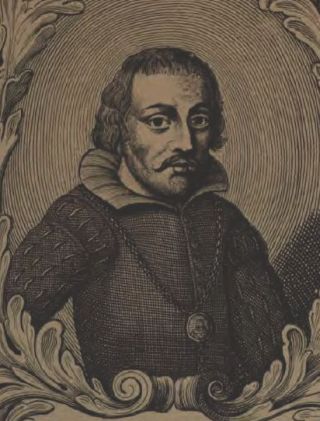
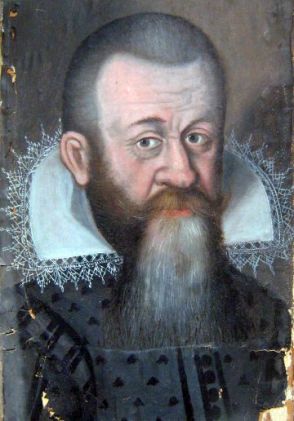
Contradicting information exists about the origins of Jacobus Horčický. While almost all sources state (or assume) that he was born in or near Český Krumlov, S. Bohemia, in 1575, he is, without any doubt, of Moravian origin, from the small town of Bojanovice near Kojetín (D.2). There is also no doubt that he was born in a lower-class family. The traditional biography states that for some time he served with the Jesuits of Český Krumlov as a kitchen servant, where the rector Bernard Koch found out his capabilities, after which young Horčický was admitted to the Krumlov seminary of poor students in 1590. However, in Jantsch (1680) (see note D.1) he is listed to have been enrolled in the Prague seminary for poor students (S. Wenceslaus), from 1584 onwards. These two sources of information can be reconciled in case he first went to Prague in 1584, and from there to Krumlov in 1590. He attended the Krumlov Gymnasium from 1590 to 1596.
According to the traditional story, while he was in Krumlov, he spent most of his time in Krumlov's college pharmacy, which was managed at the time by a lay father who was very well versed in chemistry and pharmacy: Martin Schaffner (born in Olomouc around 1564, died in Krumlov in 1608), who not only cured the members and students of the college with his medicine, but also had a flourishing practice in the city and its surroundings. Under the guidance of this experienced man, after having graduated from the Krumlov Gymnasium, Horčický completed his training in the art of pharmacy in two years.
In or after 1598 he was sent to the Clementinum in Prague, where he passed the introductory stage in logic in 1602 (D.3). The traditional sources say that he studied Aristotelian philosophy, but he was not impressed by the manner of teaching and preferred to continue his chemical work. The Jesuits finally allowed him to grow various herbs in their gardens in Smichov - the later botanical garden of the University - to set up a laboratory there, and to sell his distillations, which were popularly known as Aqua Sinapis. His sales were good, and he was no charlatan (D.4). The Aqua Sinapis brought him such wealth that he was able to lend the emperor enormous sums of money (see note D.4).
At the Jesuit properties of Nebusic and Kopanina he acquired some knowledge of economy, as a result of which in 1600 he became the administrator of the new college in Jindrichuv Hradec (Neuhaus in German) (D.5). From there, probably through the influence of the main landowner of Neuhaus: Wilhelm Slavata, he became, shortly before 1606, capitaneus and administrator of the properties of the St. Georg monastery of the Prague Castle. Here, he continued spending most of his spare time in the alchemist laboratory.
The traditional sources say, that his fame finally reached Rudolf who called him to his court and named him imperial chemist in 1607. He became a favourite of the emperor and received numerous presents. Then, supposedly, in 1608 he managed to cure the emperor from a grave disease, and as a result he was raised to the nobility.
We must treat this with some circumspection. Archival documents show, that in 1608, probably in October, he sent a brief letter to Rudolf II, requesting his nobilitation with the predicate "de Tepenec" (D.6). The reason for the choice of this predicate remains unknown, but it refers to a hill about 4 km south-east of Moravian Šternberk. It used to have a castle with the same name (formerly Twingenberg), once owned by King Charles 4. Nowadays, only badly preserved ruins survive (D.7). His request included the right to his coat of arms, which was based on the alchemical symbolism he used in his request. The arms are described in detail in the nobilitation by Rudolf, and appear in a book he published in 1609 (for which see below).
His nobilitation was granted by Rudolf on 20 October 1608. The text has been transcribed here. From Rudolf's court records it is known that Jacobus Horčický was enrolled by the emperor as a 'knight with two horses', meaning that he should receive a monthly remuneration sufficient to support himself and one other person (20 florins per month). He received this once in June 1608, and four more times after Rudolf's death in 1612.
In 1609, coinciding with Rudolf's letter of majesty, granting religious freedom in Bohemia, he published a book titled "The Catholic Confession, or Description of the Right Common Christian Confession, About Hope, Credence and Love" (with the help of some doctor from the Clementinum, dedicated to chancellor Lobkowitz), which went through two editions (D.8).
Under the rule of Emperor Matthias, in 1612, Jacobus became administrator of the estate of Melník, in compensation for the money Rudolf II still owed him upon his death (D.9). Not only was he a devout Catholic, but he was strongly anti-protestant, and denied the utraquist townspeople of Melník many of their rights (D.10). Tensions grew, and when he refused to appear in court, he was imprisoned in the 'white tower', from where he wrote several pleas for his release to the empress (D.11). Probably in December 1618 he was set free, together with a certain Dr. Ponzon, in exchange for Jessenius (who was imprisoned in Vienna). Together with numerous other catholics he was forced to leave the country (D.12). However, he must have been in Prague in 1619, from where he wrote his testament. The exact sequence of events here requires further study.
He came back to his Melník estate after the battle of White Mountain made it possible, and lived there until he died, as a result of falling from his horse one year earlier, in 1621. While on his deathbed he was transported to the Jesuit college in Prague (Clementinum), where he passed away on 25 September 1622, leaving the Jesuits the sum of 50,000 gold coins and his Melník estate. His grave is in the St.Salvator church in the Clementinum, near the altar of Maria's annunciation (D.13).
A number of books once owned by Jacobus can be recognised by his ex libris which he apparently tended to write on the first page, just as he did with the Voynich MS. This is described in more detail on a dedicated page. Many of these books also include ownership notes of the Clementinum library, which is consistent with the fact that the Jesuits were his main inheritors. This is, however not the case with the Voynich MS (D.14).
The numbers suggest that a list of books of Jacobus should have been drawn up, perhaps in relation with his testament. Stefan Guzy reports (D.15) that he has found Jacobus' autograph testament, but it does not include such a list of books. This was likely destroyed in the 19th century. The Voynich MS was probably given to someone before it became part of his inheritance.
According to Pelzel, in 1777 there existed several manuscript writings by Jacobus Horčický de Tepenec on the subject of chemistry and botany (D.16). Winter (D.17). also refers to writings by Tepenec, namely registries of the vineyards of the St.George cloister. The two large books are still preserved in the city archive of Třebenice, and contain a reported portrait of Tepenec, which is also shown at the top if this biography (D.18). Apart from that, little is known about these books.
Sources used for the biography of Mnišovský are listed in note E.1. The following portrait is from Pelzel (1773) (see note E.1).

The Doctor in Law, Raphael Sobiehrd-Mnišovský de Sebuzín & de Horstein, Czech lawyer and writer, was born in 1580 in Horsuv Tyn, in W. Bohemia. He studied in Prague with the Jesuits. At the age of 20 he became acquainted to Barthelemy Paprocky de Hlohol & de Paprocka Vule, exiled Polish writer, whom he helped with the composition of the Czech text of the latter's work 'Diadochus, or the succession of princes and kings in Bohemia' (appeared in Prague in 1602). Raphael completed the work himself with a dissertation about the cloisters and abbeys of the Bohemian kingdom.
After that, he continued his studies in Paris and Rome (E.2) and he became doctor in law abroad. At this time he changed his name from Sobiehrd to Mnišovský.
After his return he became royal secretary to the famous diplomat and politician cardinal Melchior Klesl, who at that time was governour in Austria. In this fuction he delivered important services as a political agent, during the war of Ferdinand II (then duke of Styria) with the Venetians. In return for his services he was appointed counsel to the government in Styria. At this time he was instructed to teach the young archduke (later emperor) Ferdinand III the Czech language.
During the troubled years of 1618-1620 he was employed by Ferdinand II for state affairs. On 1 January 1621 he obtained the title 'de Sebuzin', on 2 May 1622 he was installed as counsel in the royal appeals court of Prague "on the doctors' bench".
He was also sent to various towns in Moravia and in the Glatz County, as a commissioner of reformation, to force the protestant population to become catholic. In recompense the emperor gave him 4000 florins from the royal chamber, for which sum he was given the domain of Bulikov near Dacice in Moravia, which had been confiscated from Jan Dvorecky of Olbramovice.
In 1628 he was named secretary to the court chancellery where he translated into Czech the ordinances, laws and patents concerning the kingdom of Bohemia and its incorporated territory. In 1635 he became royal procurator.
When the Saxon invasion was repelled, the imperial general Albert of Wallenstein, duke of Friedland named him member of the "Friedland commission of confiscation", which was charged in 1632-1634 to punish the emigrants and those Czech nobles who had accompanied and helped the Saxons in their expedition into Bohemia. When, on 25 February 1634, Albert of Wallenstein, duke of Friedland, and his general Adam Erdman Trcka count of Lipa were murdered in Cheb, being suspected of high treason, Raphael was put in charge of the criminal process of both men, with the aim to justify the confiscation of their goods.
In 1637 he was named counsel in the royal appeals court of Prague "on the royal bench" and in 1640 he became vice-chamberlain of the cadastre of the noble countries in the Bohemian Kingdom.
Apart from Bulikov he owned Lochkov, which he had bought from Venceslas Michna in 1637, two houses in Prague, vineyards near Prague and near Litomerice, end finally a farm at Vrsovice. All this was inherited by his wife Rozina de Hirsov and two daughters, one of which was married to Daniel Pachta de Rajov.
He died on 21 November 1644 and was buried in the St. Salvator church in the Clementinum in Prague (E.3).
Mnišovský was strongly interested in alchemy and in secret writing. Possibly for Ferdinand III he wrote the Latin work: Constructio seu strues Tritemiana. Qui nullum unquam idiomatis bohemici calluit verbum, per eam in momento scribet convenienter bohemice quantum volet (etc). This is an adaptation of the method of Trithemius using the Czech language (E.4). The manuscript is now preserved in the library of the University of Uppsala, where it was transported by the Swedes during the 30-years war (E.5).
In 1630 he wrote two letters, to Vilem Slavata and to emperor Ferdinand II, to seek support for the famous alchemist Michael Sendivogius (E.6). In the second letter, we find many interesting statements: that he had studied alchemy for more than 30 years, that he studied many manuscripts of Rudolf, both in plaintext and cipher, and that he himself found many such manuscripts in the cloisters of Braunau and Kremsmünster. Furthermore, that he is one of the very few people with whom Sendivogius speaks freely. This is of interest as Sendivogius was long active in the service of Rudolf II.
The physician and minor poet Joannes Christofer Daisigner, composed a number of epigrams which included one about Mnišovský, in which he describes the latter as: Vincit Trithemium atque Gebrum: he defeats Trithemius and Geber (E.7). Daisigner was in Italy in 1639 or 1640, as one of the travel companions of Marci. (See the biography of Marci below for more details).
Mnišovský was an apt Latin poet who has composed 540 Latin poems, mostly epigrams. Shortly before his death he composed a funerary poem for himself. All are collected in: "Funebria Raphaelis - Mnissovsky de Sebuzin, quae sibi vivens adhuc valensque fecit". He had his own funerary poem printed with the instruction to distribute it at his funeral (E.8).
The historian Bohuslav Balbín, good friend of Marci, wrote about Mnišovský:
I knew the man, and for all his grave and stern face he was extremely kind and witty: I could give many examples of the fact.
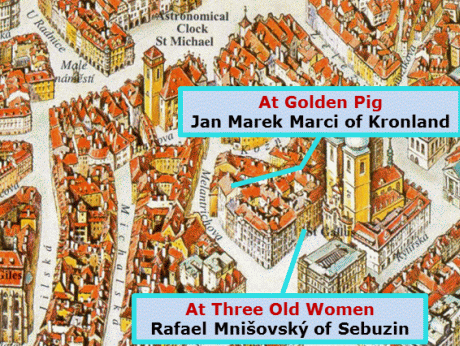
One of his houses, called "at the three old women", was located round the corner from Marci's house (IMAGE).
Since only very few sources related to Barschius are available, note F.1 includes the complete list as it is presently known to me. Most of these sources have been found by Rafał Prinke and Josef Smolka. The following biography is the first and most detailed biography available for him. No portrait of Barschius is believed to survive.
Relatively little is known about Barschius. He was born in the village Synkov near Častolovice in Bohemia (F.2). His birth year is unknown. It can be estimated from the date of his baccalaureate (1602) (F.3) and by extrapolating back (F.4) from his estimated death (F.5), to have been - most probably - around 1580 - 1585.
Barschius was catholic (F.6). Despite his rural origin, he studied at the Jesuit college of the Clementinum and received his bachelor's degree on 9 May 1602 and his master's degree on 14 May 1603, both in "liberal arts and philosphy" (see note F.3). On 27 April 1605 he started studies in Rome, at the Sapienza university (F.7). We do not know how long he was there, and he does not seem to have obtained a doctor's degree (F.8). It is possible that he followed a legal study there (F.9). He may possibly have been in Rome at the same time as Mnišovský. He was certainly back in Bohemia in 1616 (F.10).
Barschius must have first met Marci some time before 1625, probably around 1622 (F.11). Since that time they were engaged in philosophical discussions. As from 1624, Barschius was registered as a citizen in Prague (F.12). It is not excluded that he already resided in Prague before. To obtain the citizenship, he presented a recommendation letter from Johann Otto Freiherr von Oppersdorff, lord of Častolovice, which was already prepared in 1616. He had two guarantors, named Lorenz Czybut and Kasspar Punczman, and no registration fee is mentioned (F.13).
From 1630 to 1646 Barschius worked as relator at the Highest Prague Burgrave court of justice (soud nejvyssiho purkrabstvi prazskeho) (F.14). This was a high position, and it may be concluded that financially Barschius was well off (F.15).
Sometime between 1627 and 1637, Rafael Mnišovský spoke with Marci about the Voynich MS (F.16). At this time, Barschius may have already been the owner of the MS, in which case he would have been present at this discussion. In general, since both Barschius and Mnišovský were highly placed legal officials, and both shared a great interest in alchemy, it seems almost certain that both men knew each other.
In the second half of 1637 Barschius contacted Athanasius Kircher in Rome, in order to seek his help in interpreting the Voynich MS. His questions were included in a letter from the mathematician Theodor Moretus S.J., which has unfortunately not come down to us. He included some copies of text and drawings of the MS, and a sheet of other 'unknown writing' which he thought might be similar (F.17). This is the first known letter from any Bohemian scientist in the Kircher correspondence. It was triggered by the publication of Kircher's book "Prodromus Coptus, which appeared in 1636 (F.18).
The reply from Kircher came only in March 1639, and is included in the scientific diary of Moretus (F.19). The second 'unknown writing' was recognised by Kircher, but not that of the Voynich MS. Barschius found the reply not adequate, and sent a second letter in 1639. This letter has been preserved (F.20), though another batch of transcription material of the Voynich MS, which he sent to Kircher with this letter, is also lost. In this second letter he presents Kircher with his view that the Voynich MS represents "Egyptian medicine" brought to Bohemia by a traveller. He stresses the importance he attaches to the study of medicine.
In Marci's 1640 letter to Kircher (F.21), he describes Barschius as his friend. He also calls him 'greatly skilled in chemical matters', the same epithet that he would later use in "Philosophia Vetus Restituta". With this letter, Marci sends some drawings of Barschius to Kircher, but also these have been lost. It is likely, but not certain, that these drawings were copies of Voynich MS pages. Marci stresses that Barschius is interested in this subject for the sake of medicine, and not for gold. This undoubtledly refers to their common interest in alchemy, a topic that Kircher would never accept.
Both in a letter written in 1641, and in his book of 1662, Marci mentions Barschius 'in the same breath' as Martinus Santinus S.J.. Santinus was one of Kircher's corresondents, and Barschius and Marci together had managed to convince this Jesuit of the usefulness of alchemy, after he was also originally skeptical (F.22). Santini also wrote to Kircher about an alchemical puzzle, using the typical 'Oedipus' terminology (F.23).
J. Fletcher mentions (in Fletcher (1972) (see note F.1)) that Barschius had visited Kircher in Rome and on his way back wrote that he "admired Kircher's opera ingeniosissima", while referring to the letter from Barschius to Kircher. This quote does not appear there, and has not yet been found back elsewhere in the correspondence. Fletcher must have been mistaken, but this is worth a further investigation.
Barschius' name does not appear in the tax rolls called "Berní Rula" (F.24). This means that in 1654, when these tax tolls were generated, Barschius may have already died, or alteratively, that he had no taxable income (e.g. a house). Barschius never married (F.25).
Apart from the one letter to Kircher, there is no extant writing of Barschius, and he seems to have spent the last years of his life studying the Voynich MS (F.26). At Barschius' death he left Marci his alchemical collection and library (F.27) and we know that he died between 1646 and 1662 (see note F.5), but we don't know more precisely when. Extrapolating (see note F.4) his most probable birth years results in the time frame 1650-1655. No references to his death have been found in Marci's letters to Kircher (F.28).
For Marci's biography, a large number of scholarly sources are available. The most important ones used here are listed in note G.1. Other sources are indicated where applicable. The following portrait from his book "Idearum operatricium idea (1635) is his only known contemporary portrait.
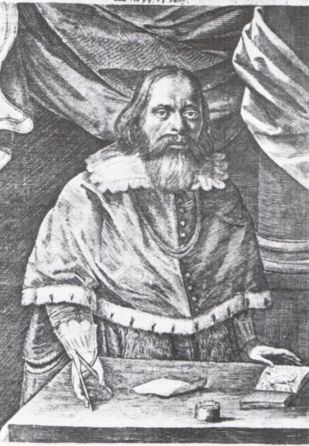
Joh. Marcus Marci was born on 13 June 1595 in a Bohemian bourgeois family in Lanškroun (German: Kronland). At this time, Rudolf II was 43 years old and had another 16 years of reign in front of him. Johannes Marcus had a younger brother David and one sister (G.2). When he was 6, the family moved to Litomyšl. In 1608 Marci began his studies at the Jesuit college of Jindřichův Hradec (German: Neuhaus). The names of both Joh. Marcus and David are still visible in the school register today (G.3).
After that he studied philosophy at the Jesuit University in Olomouc, which he completed in 1618. His education clearly aimed for a Jesuit career. His brother David entered the Society of Jesus, but was later excluded for an unknown reason.
Some time after 1618 (but we don't know how long) he came to Prague to study medicine, but there was no medical faculty before 1622. There has been some controversy about the reason why he selected a medical study rather than a Jesuit career. The suggestion from his Jesuit biographer (G.4), that this was because of his poor health and weak voice, so that he would never be able to deliver a sermon, is no longer believed. In terms of health, Marci only had some eye problems and reached the advanced age of 72.
The period between 1618 and 1622 remains an unknown part of Marci's life, and different opinions have been expressed by early historians (G.5). There are reasons to believe that Marci met, or even was inspired by Jessenius, but that he preferred not to talk about this due to the fall of Jessenius after 1621, but there is no evidence for this (G.6). As soon as the Prague University came into the hands of the Jesuits, in 1622, the medical faculty was opened and Marci became one of its first students. At this time the university chancellor was Martinus Santinus S.J. (G.7), who was also Marci's theology professor (G.8). He graduated on 17 April 1625 with the defence of his outstanding thesis "De temperamento in genere". In this, he already used some alchemical principles, so by then he must have known Barschius already for some time (see note F.11). Santinus is recorded to have remarked: "Good God, when did he get into this labyrinth?" (G.9), but he still approved of the work. Much later, Santinus himself would become convinced of the usefulness of alchemy.
Marci had important protectors such as the family of Zdeňek Lobkovic and the Archbishop Ernst Adalbert von Harrach, who had been his classmate in Jindřichův Hradec (G.10). Immediately after receiving his doctor's degree Marci started lecturing at the medical faculty of the university, which would remain his place of work for the rest of his life. In 1626, he was appointed Chief Physician of the Bohemian Kingdom. (He eventually passed this office to his son Johannes Georgius.) In 1630 he became professor at the Charles University.
Marci married around 1630, when he was about 35 years old. His wife, whose first name is not known, was the daughter of the famous gem cutter Octavio Misseroni, who had come to Prague from Milan in 1588 to work at Rudolf's court. She was therefore also the sister of Dionysius Misseroni, also a gem cutter and later custodian of Rudolf's Kunstkammer. This marriage immediately placed him in the high society of Prague. In 1631 Marci's first son Johannes Georg (Jan Jiři) was born (G.11). He had a second son Philip, born in 1634 (G.12), who drowned in the Vltava river in 1650 (G.13). Further named children of Marci are Lucie, Jan Ludvik and Barbore Cecilie (G.14).
In 1635 he published his book "Idearum Operatricium Idea", on the questions of conception and the development of the embryo. It was heavily attacked by the Jesuits and in particular the philosopher Rodericus de Arriaga S.J., who was the dean of the faculty of theology in the Clementinum. This was the start of a long-lasting difference of opinion between these two men. Marci was branded a heretic, and the book could only be published after the intervention of the Archbishop of Prague, Cardinal Harrach.
In 1638 he first became dean of the faculty of medicine, after the separation of the Charles University from the Clementinum. He held this office for many years. In 1639 he published his first work as a physicist: "De proportione motus", which deals with motion and dynamics.
Sometime in the time frame 1638-1640 Marci undertook a journey to Italy. Many details of this trip have been disagreed about among historians. His fellow travellers seem to have been Baron Franciscus Šternberg, the instigator of the trip, Fr. Ignatius Roio S.J. and the physician and minor poet Joannes Christopher Daisigner, who has left an account of this trip (G.15). Also Roio was one of the people who was originally opposed to the ideas of alchemy, but could be convinced by Marci, presumably with the help of Barschius (G.16). In earlier works about Marci this trip has been described as a mission whose task it was (among others) to get support from the church hierarchy in Rome in the fight against the Jesuits, but this is no longer believed. It is believed that Šternberg was the instigator of the trip, and it is sugggested that one of the main drivers was that he wanted to meet Kircher (G.17).
What is least certain of all is the start date, and Marci himself is unclear about it (G.18). On his way, he met the mathematician Paul Guldin in Graz and while at his house he had a chance to read Galilei's freshly published "Discorsi". He had also intended to meet Galilei in Arcetri, but this meeting did not take place. It was during this journey that he met Athanasius Kircher and this marked the start of their long friendship, and 25 years of correspondence. While in Rome, Kircher introduced him to the study of Oriental languages, in particular Arabic.
The details of the end of the trip are more clear. Marci returned via Regensburg, having separated from his travel companions, and wrote his first letter to Kircher from Regensburg on 3 August 1640 (G.19). On 12 September he wrote his second letter to Kircher, after he had returned to Prague, and in this letter he added a recommendation of the character of Barschius (G.20). On 3 November he wrote a letter to Galilei (G.21), apologising for not being able to meet him. A draft of an answer from Galileo to Marci, dated 1641 and dictated by the blind Galilei to his son, was discovered in 1975, but this was stolen from the antiquarian shop where it was on display, before it could be published (G.22). After this, a very active exchange of letters between Marci and Kircher took place, related to scientific matters, requests for books and a planned visit of Kircher to the court of Ferndinand III.
In 1646 Marci visited the newly formed medicinal springs in Hornhausen. He used the occasion to try to cure his eye problems. He also wrote a letter to Kircher about this visit, from Hornhausen. This letter was not written in his own hand but by a scribe (G.23). In 1648 he was present at the court in Vienna, and attended a demonstration by the Baron von Richthausen ("Baron Chaos") of a transmutation of Mercury into gold (G.24).
Marci also could not escape becoming involved in the war. Some time in 1641 Marci tried to decipher some intercepted code letters from the Swedish army commander Gustav Banner, and eventually sent them on to Kircher for decipherment, being certain that this omniscient man would be up to that task. (We do not know if he was). In 1648, when Prague was besieged by the Swedish army, Marci in person took part in the defence of the city, at the command of a student military unit which he himself had organised. For merit gained in the field he was promoted to the nobility in 1654 and given the title 'de Kronland'.
In his fight against the Jesuit supremacy over the Prague University he was less successful. He was delegate of a special commission of the medical faculty to negotiate the merge of both parts of the university (the secular Charles University and the Jesuit Clementinum). The Jesuits favoured the merge and the seculars declined it. Marci had worked out new statutes for the university on the assumption that authority be given to the emperor. Anyway, in 1654, the merge did take place, by command of the emperor Ferdinand III.
In 1648-1650 Marci published three books on optics. These, as well as his earlier work on dynamics have been accused of lacking clarity and the precision of observation and the genius that would have allowed him to make the discoveries that eventually befell to Newton. The most famous of the three was Thaumantias, liber de arcu coelesti. Marci was also very much aware of his isolation in Prague, and the lack of contact with the main scientists of his days. His correspondence with Kircher shows a continuous stream of requests for books, mostly, but not uniquely, the ones written by Kircher himself.
As a doctor, Marci was very successful. He was appointed official physician to Ferdinand III and, after he soon died, to his successor Leopold I. In 1655 he cured the historian Bohuslaus Balbin from smallpox, a serious illness, after he had already been given up by three other doctors. Since that time the two men became good friends and Balbin started to write extensively about Marci's medical practices (G.25).
After a few minor publications, including works on squaring the circle, on longitude and a polemic against the Jesuit B.Conrad, Marci abandoned publication for a number of years. In 1655, he sent his son Johannes Georg to Rome, entrusting him to Kircher's care (G.26). In 1658 Marci took leave from his university post as dean of the faculty of medicine, in order to accompany Leopold I on his triumphant coronation tour (G.27).
His next major publication was "Philosophia vetus restituta", in 1662 (G.28). In this, Marci confirms his original philosophical ideas that had upset the Jesuits, particularly Arriaga. In this book he also mentions that Baresch had been his friend for 40 years, had died and had left him his alchemical library, which apparently included the Voynich MS (G.29).
There is a gap in the correspondence to Kircher from 1658 to 1665. It is not clear whether Marci did not write to Kircher during these years, or whether these letters have been lost. Marci's penultimate letter to Kircher is the one accompanying the Voynich MS, written in August 1665 (G.30). This letter, like the last surviving one that was sent one month later, were again written by the same scribe who wrote the letter from Hornhausen (see note G.23). In December 1666 he wrote his last will, in which he bequeathed his entire valuable library to his son Johannes Ludwig (G.31). Because of his degraded eye sight he could not sign his will at all. It was signed only by 3 witnesses - 2 professors of the medical faculty (Marci's former students Franchimont and Forberger) and by Christophorus (Krystof) Kyblin, a legal person. Two letters written by G.A. Kinner to Kircher in early 1666 and early 1667 include questions by the ailing Marci, about Kircher's success in decipering the mysterious MS that he had sent to him (G.32).
Marci died on the 10th of April 1667, in the 72nd year of his life, from a cerebreal haemorrage. A Jesuit biography of Marci states, that a few days before his death he became a member of the Society of Jesus. Modern historians are skeptical about these events, and it is considered possible, that he was no longer conscious when this happened, if it did at all. Marci was buried in the Jesuit crypt in the S.Salvator church in the Clementinum, close to his adversary Arriaga, who died at about the same time. The crypt was investigated in 1967 by a small team including Zdeňek Servít and Josef Smolka, but the graves had already been disturbed before that (G.33).
Some works of Marci have been published posthumously by his student J. Dobrzensky de Nigro Ponte (himself later Rector Magnificus of the Charles University), who used Balbín's notes. This included "Liturgia Mensis", devoted partly to epilepsy, published 11 years after Marci's death.
Marci's library, which should have also included the remains of Barschius' library, and possibly the letters he received from Kircher, was inherited by his son Johannes Ludwig. The latter entered the Augustinian monastery of Zahan (Sagan in Silesia), where he deposited this library. From there it disappeared without a trace (G.34). The letters from Kircher to Marci have also never been found. Marci was survived by his pupils Sebastian Christian Zeidler, Jacobus Forberger and Nicolaus Franchimont of Franckenfeldt. None of them have written to Kircher, or at least no such letters are extant. One letter from Dobrzensky to Kircher has been preserved (G.35). Another letter from Ardensbach to Kircher, written in 1668 and disussing Marci's interest in alchemy, is published in Smolka (2016) (G.36).
A vast number of scholarly publications deal with Kircher's life, his interests and his published works. A short summary of publications used here is given in note H.1. Previous versions of this biography were derived from his own account (H.2). In the present version, most of the less relevant material has been removed, and the interested reader may refer to Godwin (see note H.2). A further critical review, taking into account more recent studies of his life, will be necessary.

Athanasius Kircher was a contemporary of Marci, and while he was significantly more famous than Marci in his days, also he has left little impact on modern times. He was born in Geisa near Fulda, on 2 May (the Feast of St Athanasios) in 1602 (H.3). Athanasius was the youngest of nine children, and he learned Hebrew from a Rabbi in addition to the regular curriculum of the local Jesuit school in Fulda. He reports that his childhood was full of dangerous incidents, and he miraculously survived all of them, so that already in his youth he felt favored by God and marked out for some special destiny (H.4).
By 1620 his novitiate was completed, his first vows taken, and he began the study of scholastic philosophy. His education was interrupted by the onset of the Thirty Years' War. In late 1621 Duke Christian (the Younger) of Brunswick, a convinced protestant, was approaching Paderborn. In January 1622 Kircher and two others fled the city, and graually travelled to Cologne, where he resumed his education and completed his course in philosophy. In 1623 he was transferred to Koblenz to pursue his studies in the humanities and teach Greek at the Jesuit School there.
He went to Heiligenstadt, where he taught mathematics, Hebrew and Syrian. When the Elector Archbishop of Mainz paid a visit to the College, Kircher, who loved mechanical inventions, arranged an astonishing display of moving scenery and fireworks. As a result he Elector invited him to his court at Aschaffenburg. Kircher also pursued researches into the phenomena of magnetism, out of which was to come his first book, "Ars Magnesia", completed in 1629 and printed in 1631 (H.5). On the Elector's death, he returned to his college in Mainz for another four years.
In 1628 he was ordained priest, and entered his Tertianship at Speyer. A new world of fascination opened for him when he saw for the first time pictures of Egyptian hieroglyphs. This planted the seed for his lasting interest in this topic. From Speyer he was moved to a teaching position in Würzburg. In 1630 he petitioned the Superior General of the Order to let him go as a missionary to China, but his request was refused and he had to rest content with collecting materials sent back by other missionaries. In 1631 the Swedish army entered the region. One night Kircher had a premonition of impending danger, and soon enough Gustav Adolph invaded with his Protestant troops, the College was hastily disbanded, and Kircher had to flee to Mainz with his disciple Caspar Schott, leaving behind all his manuscripts.
In October 1632 Kircher arrived at the Jesuit college of Avignon. He attracted the interest of Nicolaus Claude Fabri de Peiresc, who had a great interest in egyptian hieroglyphics. Perhaps the main reason for Peiresc's interest was that Kircher claimed to own a document in Arabic that would help in the translation of hieroglyphs. This was his famous MS of Barachias (H.6). While in Avignon, Kircher was also experimenting with his sunflower clock.
In 1633 the father general of the jesuits issued an order that Kircher should go to Vienna. Kircher later claimed that this was to succeed Johannes Kepler as Mathematician to the Habsburg Court, but this seems doubtful (H.7). Peiresc wrote letters to the authorities, including Pope Urban VIII and Cardinal Barberini, to recommend him for a post in the Collegium Romanum in Rome, but did not immediately have success. Kircher prepared for his journey, first to Aix, where he gave disappointing demonstrations of his sunflower clock, and of his translations of hieroglyphs. Still, his transfer to the Collegium Romanum was agreed, and he seems to have arrived there in November 1633 (H.8). This was to be his home now until his death, initially as a professor in Mathematics, Physics and Oriental Languages.
In 1636 he published his third book, which was the first related to Egyptian Hieroglyphs, his "Prodromus Coptus sive Aegyptiacus". It was printed at the Propaganda Fide in Rome (H.9). This is the book that triggered Barschius in Prague to contact Kircher with respect to the Voynich MS (H.10).
In 1636 Friedrich, Landgraf of Hesse-Darmstadt, the ruler of Kircher's home state, was converted to Catholicism, largely through Kircher's efforts. He was received into the Church with great solemnity in Rome, and soon afterwards made a Cardinal. Wishing to travel in Italy, he selected Kircher as his father-confessor and traveling companion. The party visited Sicily and Malta. Everywhere Kircher took the opportunity to explore new areas of natural science: mirages, zoology, vulcanism and much else. He was eager to see Syracuse. In March 1638, as they were setting out on the return journey, Etna and Stromboli erupted. There was an earthquake, and they witnessed the destruction of the island of St Euphemia. When they reached Naples, the Vesuvius threatened to erupt, too. Kircher climbed to the top of the volcano and had himself lowered into the crater to observe the process more closely.
From 1638 onwards his travels were merely local. He was made Professor of Mathematics at the Roman College, a post which he held for eight years before he was completely relieved of teaching duties. Now he began to publish his major works, apparently concentrating on a different subject every three or four years. His reputation brought scholars, letters and specimens to his study from all over the world. In 1651 he was made curator of a collection (H.11) donated to the Jesuits by Alfonso Donnino of Toscanella, which he managed to convert into a veritable museum of artefacts, curiosities of natural history, and scientific apparatus. This "Museo Kircheriano" became one of the first public museums and attracted visitors from all over Europe. IMAGE: Kircher's museum
Kircher was able to work steadily, publishing one book after another, writing hundreds of letters and interviewing innumerable visitors. Some of these included princes, who could not be refused when they asked for souvenirs from the collection. One of the most famous visitors was Queen Christina of Sweden, whose conversion to Catholicism was partly due to Kircher, and who was to stay in Rome. He was also joined by his old pupil Caspar Schott, from Würzburg days, and the editor of his unpublished papers.
In 1661, while searching for antiquities near Marino, he found the ruins of an old church, pronounced in an inscription to have been built by the Emperor Constantine on the place where St Eustace saw his vision of Christ in a stag's horns. Kircher decided to restore and reinstate it as a place of pilgrimage, and his fame and connections brought ample contributions to the work. He and other Jesuits received pilgrims there every year at Michelmas (29 September), and it became his favorite resort at other times. Here again, his excavations and field trips led to the publication of a book on Latin antiquities.
In his later years, Kircher found himself under attack by alchemists and others who no longer had any fear of disputing Jesuitical authority. He also had his share of the ailments of old age. From 1678 he was mainly occupied with spiritual exercises, and he died on 27 November 1680. His body was buried in the Gesù, and his heart in the church he had so lovingly restored.
See note J.1. The following portrait is from a photo preserved in the Beinecke Rare Book and Manuscript library of Yale University.

Joseph Strickland never owned the Voynich MS, but he is of great interest for its later history. The sale of the MS collection including the Voynich MS, from the Society of Jesus to Wilfrid Voynich, was facilitated by him. He certainly knew all the interesting details of this sale that we do not know, so a study of his life and deeds is of interest.
Father Joseph Strickland SJ was born in Malta on 14 June 1864 from noble parents: his father was Naval Commander Sir Walter Strickland of Sizergh, and his mother was heiress of the fifth Count della Catena in Malta. He was their third son. He entered the college of Mondragone in 1869, but he was called back home already in September of the next year. Before returning in 1875, he was a student at the colleges of Feldkirch in Austria and Stonyhurst in England. He stayed at the Mondragone until 1879. Two of his brothers, Paul and Gerard, equally studied there.
In the four years between his graduation and entry in the Society of Jesus he travelled a lot, and he became fluent in five languages: Italian, English, French, German and Arabic. He did his probation in Castel Gandolfo and entered the Society of Jesus on 15 October 1883.
He remained enrolled in the Roman province of the Jesuits, but studied in England, the University and the Gregorian in Rome and in Croatia. He obtained his degree (literature) in 1892 at the university of Turin. In 1893 and 1894 he taught philosophy at the Mondragone, while continuing further studies at the university of Rome. He was tasked by the Father General Luis Martin to study the history of the Jesuit suppression, which he did from 1895 to 1897. He searched in the archives of major Italian cities and left considerable material, but, much to his disappointment, he had to stop this activity. After further periods in France and Italy, by 1903 he was back teaching philosophy and history at the Mondragone.
From September 1903 till 1911 he was in Florence. Here, he initiated and successfully completed the setup of the so-called Ricreatorio di San Giuseppe, which he himself used to call his boys' club (in his letters to Voynich). It was based in two locations. The first (preliminary) location was in Via Pier Capponi where he collected a group of boys that essentially lived on the streets, to give them a Christian education. The second, more official location was at an open area near the dam at the Cure area, at the foot of the hills of Fiesole. He erected the building that now is Via Cirillo Domenico 2. It included a chapel, school rooms, a music school and a theatre.
In 1908 his group participated at a gymnastic contest in Rome which was attended by pope Pius X. In January 1912 he returned to Villa Mondragone. A few remaining letters to Voynich (June 1912 to November 1913) are preserved in the Beiknecke Library. During the first World War he voluntarily served as a chaplain to the English soldiers in Malta. He died 15 July 1917 in Malta, at the age of 53. The society of ex-students of the Ricreatorio erected a bronze bust of him in the atrium of the institute, in his memory (J.2).
There is no adequate biography of Wilfrid Voynich, even though many publications deal with some aspect of his life. The following biography has been derived from such sources, and from numerous original documents (K.1). It is likely to include a greater amount of speculative information than the other biographies on this page.
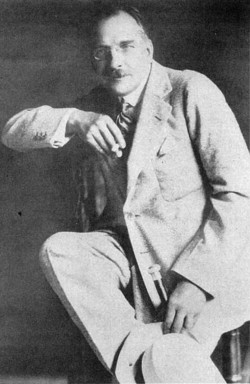
Wilfrid Michael Voynich was born on 31 October 1865 as Michal Habdank-Wojnicz, in Telsze (now Telšiai in present-day Lithuania), into a Polish noble family. To reflect his nobility, he occasionally also wrote his name as Wilfrid de Voynich (at a later age). He attended the gymnasium of the Polish town Suwałki (K.2). He studied at the University of Moscow, where he graduated in chemistry and became a licensed pharmacist. In 1885 he returned to Warsaw where he joined Ludwik Warynski's revolutionary organization, 'Proletarjat'. He was strongly influenced by the revolutionary Sergius Stepniak. In 1886 he assisted in an attempt to free fellow-conspirators Piotr Bardowski and Stanislaw Kunicki, who had both been sentenced to death, from the Warsaw Citadel. The plot was betrayed by a police spy in the group, and Voynich was arrested by the Russian police and himself put in solitary confinement in the citadel. The others were all executed.
As a result of this imprisonment, he contracted tuberculosis and acquired a permanent stoop. Later, he was sent to the salt mines in Tunka, in Siberia (K.3). While in nearby Irkutsk, he met the Karauloff family who convinced him that he must escape to England. They gave him a piece of paper with Stepniak's name and London address, along with the name 'Lily Boole', asking Voynich to greet her for them. They had met Ethel Lilian Boole while she was in St.Petersburg.
After two failed attempts Voynich managed to escape. Voynich himelf later spread the story that he made his way to Mongolia where he joined a caravan and spent months wandering with them until he reached Peking, but this is not credible, as already pointed out by Rafał Prinke (K.4). The date of his escape is 12 June 1890 and his arrival in London 5 October 1890. This is only 115 days, and a normal boat trip from Shanghai to London in those days took about as much. Instead, he went straight West through Russia, until he reached Hamburg, Germany, where, according to popular tradition, he sold his coat and glasses to buy some herring and bread and pay for a third class ticket on a fruit boat bound for England. After a treacherous journey Voynich arrived at the London docks hungry, dirty, without any money and speaking no English. Once in London, he showed the piece of paper with Stepniak s name and address to passers-by. A Jewish student who understood Russian brought him to Stepniak.
In London, Voynich quickly became part of the circle of Russian political exiles (including his future wife Ethel Boole) centred around Stepniak. Wilfrid initially used the pseudonym Ivan Klecevsky, in order to protect his parents and his sister who still lived in Russian-controlled territory. In 1891 he was one of the founding members of the Russian Free Press Fund, set up to translate and publish Polish revolutionary propaganda for clandestine distribution in Russia. In 1894 he resigned, because he felt that he did not have enough influence in the affairs of the group and set up the rival organisation called the Booksellers' Union, but this was not successful due to lack of funds. By 1895, Ethel and Wilfrid Voynich were living together seemingly as man and wife. She had adopted his name earlier. She mostly identified herself as E.L.V..
Some time later, the couple met another Russian exile, Sigmund Rosenblum, who eventually became known as Sidney Reilly. According to legend, Reilly and Ethel ran away to Italy where they carried on a passionate affair. He supposedly told her the story of his life and then abandoned her in Florence. She then would have returned to Wilfrid, and began writing The Gadfly inspired by Reilly's life. In reality, Reilly was not who or what he claimed to be. He manufactured the details of his early life to explain much later (1918/19) how he was recruited to British Intelligence (K.5). In December 1895 Stepniak was killed by a train and the Voynich couple seem to have withdrawn from active participation in revolutionary movements at this time (K.6).
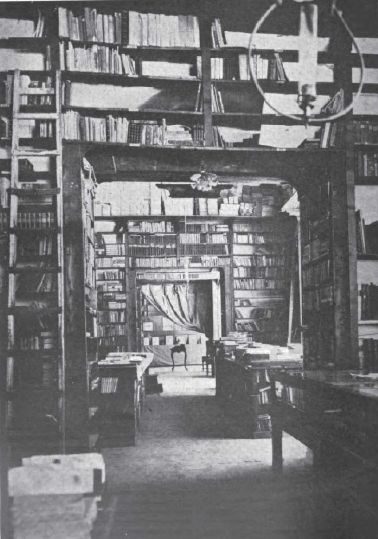
Wilfrid became an antiquarian book dealer, selecting this career on the recommendation of Richard Garnett, Keeper of printed books at the British Museum. Garnett's argument was: you just need to travel and pick up incunabula and rare books and sell them in London. Voynich issued his first catalogue ('first list of books') in 1898 in partnership with Charles Edgell, a young Cambridge graduate, who presumably helped him with cataloguing and possibly co-funded the enterprise. This first catalogue was an incredible piece of work for a beginner. It included a great amount of bibliographical detail, and was the first English catalogue to use Proctor numbers for incunabula (a system that had been divised in the same year). Only Baer in Frankfurt did this earlier than Voynich. In 1900 he opened his first London book store on 1 Soho Square (IMAGE). Later that year he issued his second catalogue, which was even more impressive than the first, and started the trend of including a section of 'Unknown, Lost or Undescribed books'. Wilfrid and Ethel eventually married in 1902, which may be connected to his (successful) application for British citizenship 1904. At this time he officially adopted the name Wilfrid Voynich.
Following up on the advice of Garnett, Wilfrid became a regular visitor to the Continent, in particular to Italy. He was able to buy large quantities of old books and manuscripts from religious houses and other places. On one occasion he visited a convent in Italy and the monks showed him their library of early printed books and codices. He reportedly told the monks they could have a most interesting and valuable collection of modern theological works to replace their dusty rubbish. Within a month he owned the whole valuable library in exchange for a lot of modern garbage (K.7). On another occasion he visited Corsica and reportedly came back with 600 incunabula (K.8).
His first great achievement in the book trade was his 8th catalogue ("eighth list of books" as he calls it), issued June 1902, consisting entirely of 'unknown and lost books', or, to be more precise, books not recorded in any bibliography or located in any library. The British Museum was interested in acquiring the lot, but while they generously valued it at 800 pounds (including a 50% increase due to the fact that all books were unique), this was only about half of Voynich's asking price. Voynich then wrote to several wealthy collectors to buy the lot and donate it to the British Museum, which is indeed what happened. Voynich became one of only two UK book dealers to have their own shelf mark in the British Museum, and most of this collection is now known as Voyn.1 through Voyn.137.
In 1905 Voynich sold a sheet of painted parchment to the British Museum for 75 Pounds. He had acquired it from another English dealer, supposedly representing Columbus landing in America. However, he (or his staff) recognised that the flag on the illustration must have been from much later, so suggested that it represented Cortez. Upon inquiry from the British Museum, the provenance could not be convicingly traced back further than a previous French dealer. Some time after 1930, this was first suspected to be a forgery from the hand of the so-called 'Spanish Forger' (K.9), but later it was ascribed to an unknown forger. All this happened after Voynich's death.
In 1908 he acquired the famous antiquarian book store Franceschini in Florence, located in the Palazzo Borghese (IMAGE). It was a vast treasure trove, which he described as "absolutely filled with incunabula" (see note K.7). His 24th catalogue was published in 1908, after opening the Florence shop, and it was titled: "A Catalogue of rare books, printed in the XV., XVI. and XVII. Centuries, not to be found in the British Museum". In 1909 he moved his London office from Soho Square 1 to the more upmarket address of 68 Shaftesbury Avenue. After this, he moved his interest from inexpensive 15th century prints to illuminated manuscripts. He carefully approached Belle da Costa Greene of the Morgan Library with some 20 illuminated manuscripts for sale which he rated at values of 400-800 pounds. In December 1912 he made his first sale to Morgan: Augustine's De Civitate Dei (1467) for 1200 pounds (K.10). He also developed the habit of looking for items hidden in the bindings of newly acquired old books and manuscripts (K.11), leading to several interesting discoveries such as the earliest xylography from Cracow (in cyrillic), a map related to Magellan's voyage around the globe and sets of early playing cards.
One aspect of Voynich's business approach is that he was a slow payer who heavily relied on credit arrangements with other book sellers. In 1910 he owed Quaritch more than 1300 pounds and in 1913 more than 500, some of which was still unpaid 2 years later. In addition, he used stock-sharing techniques with the firm of J&J Leighton, and possibly also Olschki in Florence. For this, he was viewed by Quaritch as a 'small operator', primarily dealing with other dealers, in second-rate early printed books. He issued at least one catalogue consisting entirely of incunabula ranging in price between 5 and 10 pounds sterling (K.12).
In 1912 he returned from another European trip with probably his best catch ever, a collection of valuable manuscripts, which attracted very regular visitors to his book shop (K.13). This included his famous cipher MS, and the Vitae Patrum supposedly with paintings from Giotto, possibly the most valuable item he ever handled (K.14). Two valuable manuscripts from this collection, originating from the library of Matthias Corvinus, had already been sold (via two intermediary dealers) to the Morgan Library before July 1912. This set of books had been sold to him in complete secrecy, and Voynich simply said that he discovered it in some chests in a castle in Austria, a story he later had to change in some details (K.15).
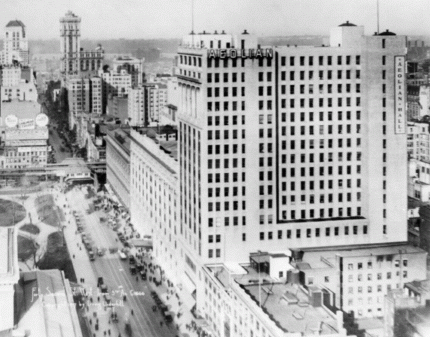
Late spring 1914 Voynich returned prematurely from a trip to the European continent, as he recognised that a war was about to break out. When this happened (World War I), his trips to the continent came to an abrupt halt. He made his first voyage to New York City in November 1914, crossing the Atlantic on the Lusitania. His home base there became New York, where he stayed initially in the Waldorf Astoria, and later in Manhattan Hotel. In January 1917 he set up an office on the 16th floor of the Aeolian Hall, on 29 W. 42nd Street (IMAGE). (K.16). Ethel Voynich emigrated to New York some time in 1920-1922.
The American Anne M. Nill became his new secretary and managed the New York office of his book business. He brought his prime collection of manuscripts and early printed books over to the US in January 1915. Early that same year he was offering the above-mentioned Vitae Patrum to Belle Greene for US$ 150,000 (30,000 pounds) which she considered preposterous. One year later, it was sold to Morgan for half the price. After settling in New York he gradually transferred more stock across the Atlantic. He retained a small shop in London, which was managed by Herbert Garland.
In the course of 1915, Voynich organised a series of exhibitions of his most interesting items (manuscripts and early prints), which always attracted a lot of visitors and media attention. After exhibitions in Princeton University and New York city, in October he exhibited about 260 items at the Art Institute of Chicago and continued at the University of Michigan (early Nov.), the University of Illinois (mid Nov.), the Albright Art Gallery in Buffalo (mid Dec.) and other museums. During this tour he sold a number of his items to the places visited.
By this time, Voynich had published at least 34 catalogues, usually well over 100 pages (K.17). Many of these have become rare collector's items themselves. Complete sets of these can be found in the Grolier club in New York (which preserves the documentation of Voynich's business from 1916 till after his death), and in the State University of New York, Binghamton University Libraries. By the time he issued catalogue 31, he ran (or was associated with) book stores in London, Paris, Florence, Warsaw and Vienna. In the course of his antiquarian career he sold a total of 3800 volumes to the British Museum (K.18).
At some point during their marriage, the Voynich couple unofficially adopted a daughter Winifred Eisenhardt, who later became Winifred Gaye. Towards the end of the 1920's both his business and his health started to deteriorate. The physical hardships he had endured as a prisoner in Poland and Siberia had compromised his health. His lungs were damaged by tuberculosis and heavy smoking, and in 1929 he contracted pneumonia while in England, from which he would not recover. After his return to the USA he died on 19 March 1930. Some time before his death, he told his wife about the secret deal he had made with the Jesuits in 1912, which included his famous cipher manuscript (K.19).
His last will and testament has recently been uncovered by Farley Katz (K.20). His long-time secretary-manager Anne M. Nill became Ethel's 'companion'. The two women lived together for thirty years, initially in Brooklyn and later in an apartment at London Terrace on West 24th Street in the heart of Manhattan, continuing Voynich's rare book business with moderate success. Ethel died in 1960 and Anne Nill in 1961.
By all accounts, Wilfrid Voynich was a brilliant man whose 'seductive' personality, facility with languages (he supposedly spoke 18 languages), wide-ranging knowledge, and keen entrepreneurial skills made him a highly successful book dealer. An interesting assessment of his character was made by Stefan Juszczynski, a member of the London polish socialist party (see note K.4):
He [Wojnicz] had exuberant phantasy and took its results for reality, in which he solemnly believed. Later he became [...] a very practical antiquarian books dealer and made a considerable fortune, which he was always happy to share with anyone. And so in that man lived in agreement incredible phantasy (others call it lies), truly American pragmatism and good heart.
Valuable contributions were gratefully received from the following persons, in alphabetical order:
Lubos Antonin (Prague),
Marcela Budíková (Brno),
Jan Bedrich Hurych (Ontario, Canada),
Denisa Kera (Prague),
Maria Macchi (Italy),
Colin MacKinnon (USA),
Philip Neal (UK),
Michal Pober (Kutna Hora),
Josef Smolka (Prague),
Rafał T. Prinke (Poznan, Poland),
Jorge Stolfi (University of Campinas, Brazil).
|
|
|
||
|
|
|
|
|