






|
|
|
|
|
|
|
|
|
|
Several authors have identified structures in the composition of words in the Voynich MS. These are presented below, roughly in chronological order. The models take on very different shapes, and can also be roughly classified into different genres. I will use the following terms for this purpose.
Descriptive models provide some rules how to interpret or analyse words, for example how to break them up into components. Predictive models go a step further, and provide rules how to build words. These terms will become more clear once they are applied to examples.
Furthermore, models can be more quantitative or more qualitative, both with respect to how their rules have been derived, or in assessing their performance.
Tiltman observed that many words in the stars or recipes section (which was the only sample that, initially, he had available for a detailed analysis) were composed of two parts. He set up the a table in Plate 17 of his publication (1), which is recreated below:
| Roots | Suffixes |
|---|---|
| | |
| | |
| | |
| | |
| | |
| | |
| | |
| |
Every combination of a 'root' and a 'suffix' gives a valid word. He roughly subdivided the suffixes into three groups, depending on whether they contain , or . Tiltman observes that the suffixes (which he also calls 'finals') are often found standing alone in the stars section of the MS.
This is an example of a descriptive model. However, we may also treat it as predictive, if we assume that every combination is allowed, and this is the complete set of rules. When we do that, and also allow an empty root or an empty suffix, this model can generate 272 different word types. While this number is extremely low compared to the actual number of word types in the MS, the majority of frequent words are included in this list. The most frequent word not covered by it is the 19th ranked (2). In fact, several of the most frequent words that cannot be modeled are due to the missing single suffix/final .
Some additional observations by Tiltman related to this are:
Tiltman also presents an observation, apparently offered to him by one Peter Long, "that the groups might represent Roman numerals. Thus might represent 'iij', and 'xxv', but this, if true would only present one with a set of numbered categories, which doesn't solve the problem. In any case, though it accounts for the properties of the commoner combinations, it produces many impossible ones."
The following pattern was contributed to the Voynich MS mailing list (3) by one of its original participants Micheal Roe. His system is represented here, both using the EVA alphabet and in Voynich characters. Each path represents a valid word, and Mike suggested that this could perhaps present evidence of grammar of the Voynich language:
                      +- o  --+  +- r -+
 o   --+           +--+       +--+     +--+
       |  +- t -+  |  +- cho -+  +- l -+  |
 qo  --+--+     +--+                      |
       |  +- k -+  |  +- e ---+           |
 cho --+           |  |       |           |
                   |  +- ee --+           |
                   |  |       |           |
                   +--+- che -+-- y ------+------>
                   |  |       |           |
                   |  +- ch --+           |
                   |  |       |           |
                   |  +- sh --+           |
                   |  |       |           |
                   |  +-------+           |
                   |                      |
                   |  +- al ---+          |
                   |  |        |          |
                   +--+- am ---+----------+
                      |        |
                      +- ain --+
                      |        |
                      +- aiin -+
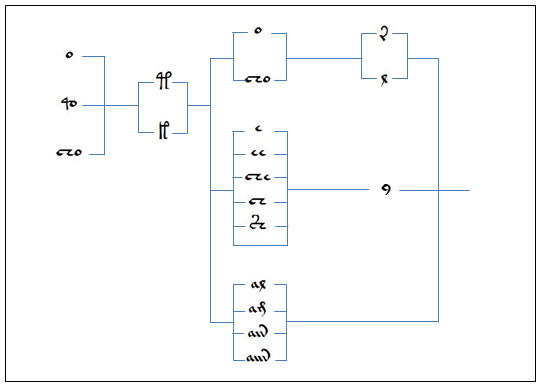
This model can generate only 84 word types, and was obviously not intended to represent all words in the MS, but just a specific subset.
Another early mailing list member, Robert Firth, based his analysis on the pages in the MS written in Currier's A language. Looking at all words (which he calls groups) that occur at least four times, he set up a list of 'odd letters' and a list of 'even letters', such that each group is composed of an odd letter followed by an even letter. This is explained in his Note Nr.24 (preserved local copy), which uses Currier's transliteration system (4).
This, again, is primarily a descriptive model. The split is not entirely unambiguous, but according to Firth, the system works reasonably for the words he considered. The approach is similar to Tiltman's split, and is illustrated below. I have taken the liberty to rearrange the two columns and group similar items together, in order to improve the layout. This also makes it more easily comparable to Tiltman's system.
| Odd letters | Even letters |
|---|---|
| | |
| | |
| | |
| | |
| | |
| | |
| | |
| | |
| | (?) |
Again, treating the model as predictive, it can generate the modest number of 483 combinations. If we were to enforce that both columns must be represented, then this model would not be able to generate any unattached finals. Adding an empty slot to the first column increases the number of combinations to 504, but a number of these are no longer unique. Since this model was derived from the A language, it does not model any of the specifically B-language words, such as fourth-ranked (overall) .
Jorge Stolfi discovered a new structure in the words of the Voynich MS, by grouping all characters into 'soft' and 'hard' and showing that the vast majority of words consists of one, two or three groups, which he calls prefix, midfix and suffix. This was primarily based on text in Currier's B language. The prefix and suffix consist only of 'soft' characters, and the midfix only of 'hard' characters. Some time after this, Stolfi also defined a more complete (yet more complicated) description of the words (see 'word grammar' below). However, the simple principle behind the prefix-midfix-suffix structure makes it worthwhile to look at first.
It is explained in detail on a preserved local copy from his original web site. It may be summarised as follows:
The following characters are 'hard' characters and build the optional midfix (usually called stem)
of a word:
.
All other characters are soft, and build the prefix and suffix:
.
The rule states that the vast majority of Voynich words are made up as one of:
This mode cannot yet be called predictive, is it does not provide any rules for the specific composition of the prefix, suffix etc.
Stolfi provides lists of the most frequent prefixes, midfixes, suffixes and unifixes, indicating that especially the soft-character groups go down in frequency very fast. This is demonstrated below in a partial screenshot of his page.
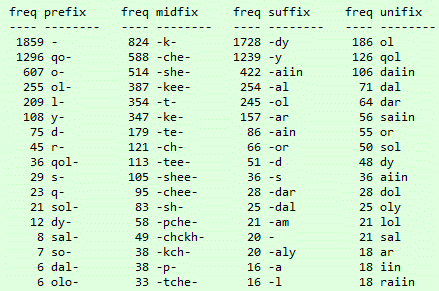
The most frequent word that cannot be modeled by this method is 112-th ranked . Undoubtedly, this is only due to the fact that he truncated his published lists.
Later, Stolfi analysed a 'fine structure' of words in the Voynich MS. This is also known as the 'OKOKOKO' paradigm. It is also explained in detail in a preserved local copy from his web site.
According to this model, strings of Voynich text (apparently ignoring spaces) may be parsed as:
Q O I X E O I X E O ...
where the characters Q O I X E can be:
| Q | or empty |
|---|---|
| O | 0 or more of |
| I | empty or one of |
| X | (5) |
| E | empty or |
He also calls the sequence "I X E" by the symbol "K", which explains the title of this paradigm. He lists the specific combinations that are allowed for K.
This, again, is an example of a descriptive model, but it provides some new insights into how characters may be combined.
Most of the features found by Jorge Stolfi were later combined into what he calls the grammar of Voynich words. It is his most complete and most accurate breakdown of the word structure into a set of rules. It is definitely a predictive model, and it is also the first model that is strongly based on statistics, and presents detailed statistics of the model's coverage of word types. All models prior to Stolfi were largely qualitative, and this was still true (to some extent) of his earlier models presented above.
The model splits all characters into three groups which Stolfi calls core, mantle and crust. In addition, the three characters , which he calls 'circles', play their own role in this system. It is explained in great detail on this page from his web site, while the formal grammar definition is here.
The relation between the earlier hard/soft distinction, and the present core/mantle/crust distinction can be shown graphically, as follows, where each item can be empty:
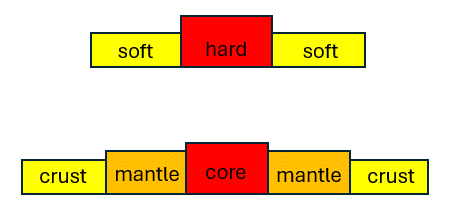
The mapping between the characters is shown in the following table:
| core | mantle | crust | circles | |
|---|---|---|---|---|
| soft | | | ||
| hard | |
() |
While the character has its own additional rules, it best fits the mantle so I have included it there for simplicity.
Emma May Smith has analysed many aspects of the Voynich MS text (6), and her work also includes a word model, formulated in May 2019. This model is based on a number of earlier analyses, from March 2015, which are worth looking into first.
The first two pages address the characters Stolfi called 'circles'. The >>first page argues that and appear in mutually exclusive locations in Voynich words, and the >>second page argues that can appear everywhere, overlaping with all locations where and appear, but also in additional locations where and seem to be missing. She refers to this situation as the 'deleted '.
These arguments are based on quantitative statistics of word types and appear convincing. They lead to a >>low-level word structure which is reproduced below. This appears to be largely consistent with Tiltman's model, but significantly more detailed. However, there is one important difference: the 'circle' part of the final is moved from the final/tail to body/root, where it is called 'prime'. The slashed zero symbol in the green 'Prime' field is the above-mentioned 'deleted ', which appears when or a string of is not followed by .
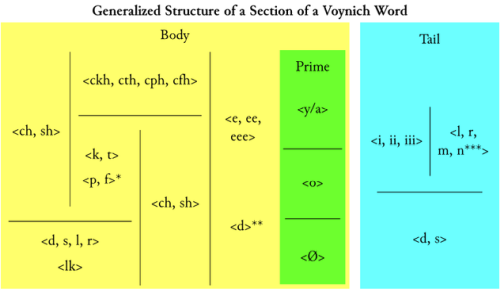
* The characters <p,f> can only take <e,ee,eee> if there is <ch,sh> in between them
** Must have <ckh,cth,cph,cfh> or <ch,sh> directly before; can only take <y> as prime
*** Can only have <n> after <o> if <i,ii,iii> between
The >>final model is strongly based on this work, but also introduces linguistic aspects. It uses the terms vowels, consonants and syllables, even though there is no evidence that the Voynich symbols represent vowels or consonants (7). However, we can ignore this linguistic association and just understand the terms to refer to certain groups of characters. The following figure illustrates the other terms she uses (based on linguistic theory) (8):
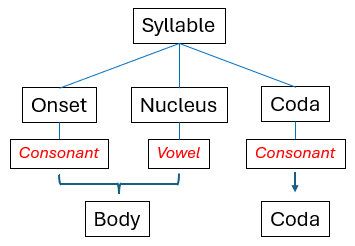
The model then describes the rules for splitting words into syllables composed of bodies and codae, where bodies end with a circle (including deleted ), and the coda is equivalent with the 'Tail' in the above figure.
This model is descriptive, but based on quantitative information. It also expresses its quality in quantitive terms, as it covers most or all word types that appear at least four times in the text.
Several authors have independently arrived at the idea that the words of the Voynich MS could be generated by picking subsets of characters from slots. This is best described by the examples that are given below.
The first example that I am aware of is included in a series of posts in the Ninja Forum (see note 3) by a contributor writing under the name (or pseudonym) ThomasCoon. Starting on 30 October 2016 he posted two slightly different versions. Below, I copy the first, with only editorial changes:
| 0 | 1 | 2 | 3 | 4 | 5 | 6 | 7 | 8 | 9 | 10 | 11 |
|---|---|---|---|---|---|---|---|---|---|---|---|
| q d |
s ch sh |
o e y ol |
k t p f |
ch sh |
e ee eee |
o a |
r l |
d s ch |
a o |
n m in r iin l |
y |
Words can be constructed by picking items from some of the columns, always from left to right. As an example of its application, the word choteol can be constructed by picking items from columns 2, 3, 4, 6, 7 and 8 (in that order).
This is a clear example of a predictive model, as it states rules for constructing Voynich words, some of which may not exist. This is true for all slot models.
Following is the second version:
| 0 | 1 | 2 | 3 | 4 | 5 | 6 | 7 | 8 | 9 | 10 | 11 |
|---|---|---|---|---|---|---|---|---|---|---|---|
| q d |
s ch sh |
o a y ol |
k t p f |
ch sh |
e ee eee |
o a y |
r l |
d s ch t? |
o a |
n m in r iin l |
y s |
The most frequent word that cannot be modeled by this system is one that includes a pedestalled gallows, namely 44th-ranked .
It is of interest to compare this system with Stolfi's prefix-midfix-suffix paradigm. Using the second grid, let us see which slots have soft or hard characters.
| 0 | 1 | 2 | 3 | 4 | 5 | 6 | 7 | 8 | 9 | 10 | 11 | |
|---|---|---|---|---|---|---|---|---|---|---|---|---|
| soft | q d |
s | o a y ol |
|
o a y |
r l |
d s |
o a |
n m in r iin l |
y s |
||
| hard | ch sh |
k t p f |
ch sh |
e ee eee |
ch t? |
This split only follows the slot separation to a very limited extent.
In 2021 I wrote a paper in which I demonstrated that the method proposed by Gordon Rugg, in which he proposed that the MS was created as a fake by moving grids over a large table of word fragments, can be generalised into a slot alphabet. In this case, each slot does not necessarily include single characters, but can also have character combinations. The paper is available both online and locally (9).
The most recent and well-documented example was presented at the 2022 Voynich MS Conference organised by the University of Malta. Both the paper and the presentation by Massimiliano Zattera are available online (10). His slot alphabet is included below, again with only editorial changes.
| 0 | 1 | 2 | 3 | 4 | 5 | 6 | 7 | 8 | 9 | 10 | 11 |
|---|---|---|---|---|---|---|---|---|---|---|---|
| q s d |
o y |
l r |
t k p f |
ch sh |
cth ckh cph cfh |
e ee eee |
s d |
o a |
i ii iii |
d l r m n |
y |
In his publication he analyses the quality of this model in significant detail, and he also compares it with other models. The most frequent word that cannot be modeled by it is 89-th ranked .
Also here, we can analyse how the slots are distributed over soft and hard characters.
| 0 | 1 | 2 | 3 | 4 | 5 | 6 | 7 | 8 | 9 | 10 | 11 | |
|---|---|---|---|---|---|---|---|---|---|---|---|---|
| soft | q s d |
o y |
l r |
s d |
o a |
i ii iii |
d l r m n |
y | ||||
| hard | t k p f |
ch sh |
cth ckh cph cfh |
e ee eee |
In this case, we see that the slot alphabet is perfectly compatible with Stolfi's prefix, midfix and suffix approach. In his paper, Zattera also shows the accordance of his slot system with Stolfi's grammar expressed as core/mantle/crust:
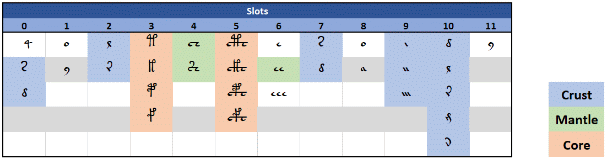
All three cases of single-character slot tables discussed above use 12 slots. It is not clear whether this is a coincidence or not. The words generated by these slot tables can be longer than 12 Eva characters.
The systems of ThomasCoon lack the pedestalled gallows, which was also the case for the systems of Tiltman and Roe. Firth's system includes them and so do Smith and Zattera.
Both specific examples (ThomasCoon and Zattera) have in common that certain Voynich characters appear in more than one slot. This is probably unavoidable, and it means that some short words can be generated in more than one way.
I consider that this last point could perhaps be avoided by having fewer slots, and allowing a cycle back between two specific points. This will be elaborated further in a future update of this page.
The results presented on this page are critically important for anyone interested in translating the text of the Voynich MS. The fact that structures like the ones discussed on this page exist, tells us that the MS text is not the result of an encryption of an Indo-European plain text using the type of encryption available in the early 15th Century. Any tentative solution working along these lines will necessarily fail.
The 'correct' (or even the 'best') word structure has not been identified yet. To measure the quality of any word model, two quantities are used (as explained also by Zattera (see note 10). The first is 'recall', which means the fraction of word types in the text that the model can generate (or explain). The second is 'precision', and this can only be computed for predictive models. 'Precision' is the fraction of word types that the model can generate (='predict'), that actually exist in the MS text.
This page shows several examples of word models, and in general one will observe that the simple paradigms have a low recall, but a relatively high precision, while the more complicated models have a higher recall but they are also expected to have significantly lower precision. The precision has not yet been computed for all models, but Zattera presents a few examples.
Finally, the existence of a restrictive word structure, whatever exact form it takes, explains the anomalously low conditional character entropy of the Voynich MS text, though what is cause and what is effect is not yet fully understood.
|
|
|
|
|
|
|
|
|
|