







|
|
|
||
|
|
|
|
|
| Voynich MS - Quire 1 |  |
|||
|---|---|---|---|---|
GeneralFor an explanation of the material found on this page, see here. DescriptionQuire 1 is a standard quire of four bifolios, containing folios 1 through 8. The quire mark (Pmus) is on f8v. There is one text-only page (f1r) and all other pages have herbal drawings.
Schematic folio layout:
| ||||
| Folio 1 |  |
|
||
|
Folio 1, together with folio 8 form a standard-sized bifolio. The folio nr. of folio 1 is on f1r. Folio 1 is strongly affected by insect holes, particularly in locations near the edges of the old binding. | ||||
 |
f1r |  |
||
>>Link to 2014 scan (Beinecke digital library) >>Link to 2004 scan (Jason Davies Voyager) General description
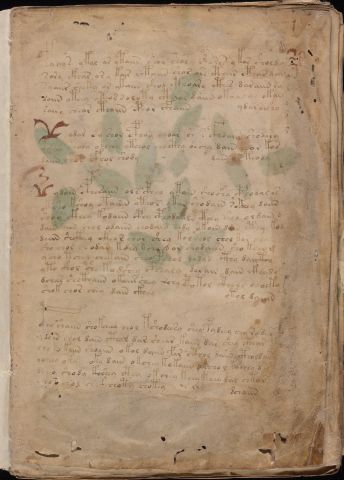
This is the first page in the MS and it appears more worn then all other pages.
It is a text-only page with four paragraphs of text.
The top, right and bottom margins of this page are badly stained. These stains are from several causes: Voynich and Brumbaugh both describe how they applied chemicals to this page, and in addition there are imprints from a previous cover of tanned leather. The page is badly affected by insect holes. Illustration(s)While the page has no illustrations, there are three red so-called 'doodles' which have been drawn in the same way as the illustrations in the MS, namely with outline drawings in ink, and afterwards painted in red. They are further discussed under the heading 'Text'. Text
This page has 28 text items (loci), as follows:
The text appears in four paragraphs which fill the entire page. Paragraphs 2 and 3 have large initials (coloured red) which are not part of the Voynich alphabet. The two symbols are drawn or painted with flaring strokes ending in swallowtail serifs. Additional writing in the stained right margin shows three columns of letters. The first column has 'a' through 'z' in a lower case italic hand. Next to these are a column of Voynich letters, of which only a few are visible. The third column seems to be 1 off from the first: italic miniscules, r next to s, and so on. More details appeared when a multi-spectral scan of this page became publicly available (see a link to the relevant information.) The folio number is not very clearly visible and there is another red mark vaguely looking like 29 below it. Brumbaugh further reports seeing the numbers 1*30 being written above the alphabet, before it was obliterated by the application of chemicals (intended to reveal faded writing), and favours the theory that it is 1630, written by the owner prior to Marci. This is no longer legible, even under UV illumination. The bottom margin of f1r contains an ex libris: Jacobj à Tepenece, visible under UV light, and of course in the above-mentioned multi-spectral scans. Additionally, there is the text "No 19". Voynich only recognised illegible characters here, and Brumbaugh reports that this should be the word "Prag"
Currier language: A
Browse interlinear transliteration of f1r Tentative identificationsThe ex libris can be positively identified to be of Jacobus de Tepenec (see more here). It is a clear indication that he once owned the book. The 'No 19' below it is a common feature of all books once owned by Jacobus de Tepenec, or at least the six that have currently been identified. The alphabets in the right margin have been tentatively but credibly ascribed to Johannes Marci Marci, see here, and visit the blog post of Lisa Fagin Davis. The two symbols left to the second and third paragraphs may be topic markers, of a type also found in other manuscripts. Other informationThe page layout suggests four quotes with attributions, or signed endorsements. It is assumed that this page was also originally meant to be the MS first page. The four paragraphs could perhaps represent a summary of the contents of the MS. It is not clear whether the alphabet table and ex libris have simply faded or have been erased. If erased, it is also not certain who would have done it, and why. | ||||
 |
f1v | |
 |
|
>>Link to 2014 scan (Beinecke digital library) >>Link to 2004 scan (Jason Davies Voyager) General descriptionThis is a herbal page. For general information about herbal pages see here. Illustration(s)
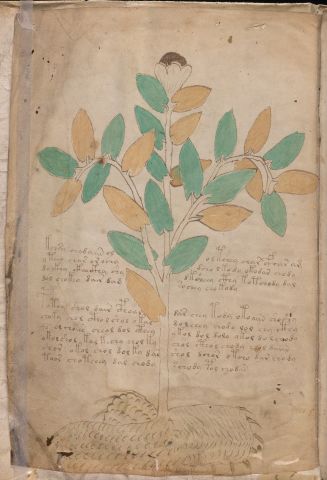
One plant centered on the page.
This appears to be the same plant as shown in fragment 204 on f102r1.
Herbal drawing characterisation (Gheuens/Rapaport):
Text
This page has 10 text items (loci), as follows:
The text is subdivided into two paragraphs, both in the bottom half of the page. The lines of both paragraphs are interrupted by the plant drawing. Under the paint of the second leftmost green leaf is the Latin character 'g'.
Currier language: A
Browse interlinear transliteration of f1v Tentative identificationsPossible plant identification: ELV: atropa, atropa belladonna; ThP: solanum, solatrium, belladonna; Other informationThe Latin 'g' under the green paint could be a colour annotation (for which see here). | ||||
 |
Folio 2 | |
|
|
|
Folio 2, together with folio 7 form a standard-sized bifolio. The folio nr. of folio 2 is on f2r. | ||||
| |
|
f2r | |
|
>>Link to 2014 scan (Beinecke digital library) >>Link to 2004 scan (Jason Davies Voyager) General description
This is a herbal page. For general information about herbal pages
see here.
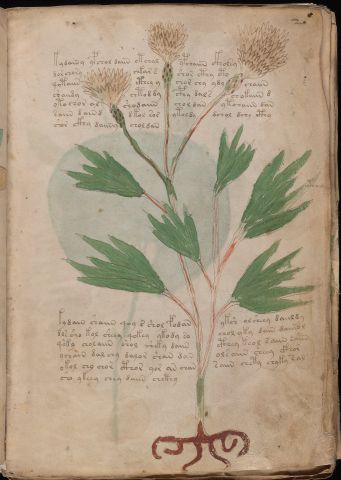
Illustration(s)A page-filling plant drawing. Small roots, a stem with leaves and flowers with dotted bulbs below them.
Herbal drawing characterisation (Gheuens/Rapaport):
Text
This page has 15 text items (loci), as follows:
The text is subdivided into two paragraphs, one near the top of the page and carefully avoiding the flowers and the other one near the bottom, on either side of the stem..
Currier language: A
Browse interlinear transliteration of f2r Tentative identificationsPossible plant identification: ELV: cyanus(?); ThP: cyanus silvestris (O'Neill), Centauria (Holm) Other informationIf the Voynich text under the green painting should also be a colour annotation, it is the only one using the Voynichese script. The writing, which seems to say: , is not composed of 'typical' Voynich words. | ||||
| |
f2v | |
|
|
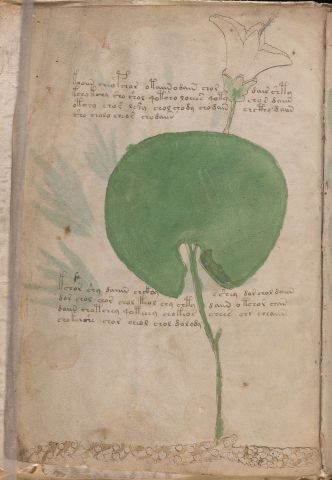
>>Link to 2014 scan (Beinecke digital library) >>Link to 2004 scan (Jason Davies Voyager) General descriptionThis is a herbal page. For general information about herbal pages see here. Illustration(s)White(?) water flower.
Herbal drawing characterisation (Gheuens/Rapaport):
Text
This page has 8 text items (loci), as follows:
The text is subdivided into two short paragraphs, one near the top of the page and the other just below the middle. Both are interrupted by the plant drawing. There is a short piece of extraneous (non-Voynich) writing just above the second paragraph. This looks like the letters 'fe' or 'fo' in a darker ink.
Currier language: A
Browse interlinear transliteration of f2v Tentative identificationsThis has often been compared with a water lily, but the flower is not a good representation of a water lily, and looks much more like a normal lily. Among water flowers, it looks more like Nymphoides Peltata (yellow floating heart), which is not endemic to Europe. The root is an accurate representation of a water lily root. ELV: Colosia? Villarsia, Limnanthemum. ThP: coliocasia, Egyptian lotus. Other informationThe extraneous writing is somewhat similar to later annotations on the alchemical herbal Florence MS 106, which are cross-references to other folios in the MS written by a later owner. This is discussed in a talk I gave in 2012, for which see slides 12 and 13 of this presentation. | ||||
| |
Folio 3 | |
|
|
|
Folio 3, together with folio 6 form a standard-sized bifolio. The folio nr. of folio 3 is on f3r. | ||||
| |
|
f3r | |
|
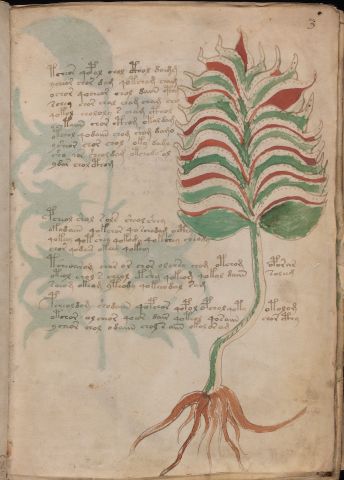
>>Link to 2014 scan (Beinecke digital library) >>Link to 2004 scan (Jason Davies Voyager) General description
This is a herbal page. For general information about herbal pages
see here.
Illustration(s)A plant with a long stem and very closely stacked leaves with alternating colours: red - white - green - white.
Herbal drawing characterisation (Gheuens/Rapaport):
Text
This page has 20 text items (loci), as follows:
The text is subdivided into four paragraphs. There is a relatively large gap between the first and second paragraph. The plant drawing cuts through the third and fourth paragraphs, leaving a single word on the right-hand side of the stem.
Currier language: A
Browse interlinear transliteration of f3r Tentative identificationsPossible plant identification: ELV: dictamnus? ThP: crassulatea (Cretan dittany) Other information
| ||||
| |
f3v | |
|
|
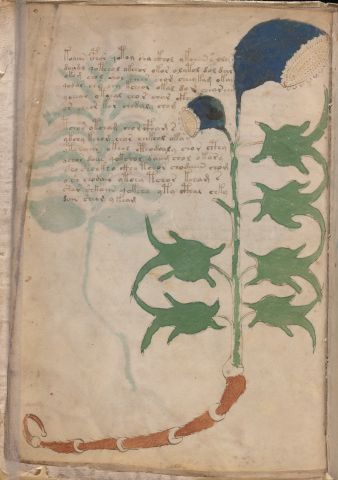
>>Link to 2014 scan (Beinecke digital library) >>Link to 2004 scan (Jason Davies Voyager) General descriptionThis is a herbal page. For general information about herbal pages see here. Illustration(s)Plant with 'telescope' roots, frog-like leaves and pods.
Herbal drawing characterisation (Gheuens/Rapaport):
Text
This page has 14 text items (loci), as follows:
The text is subdivided into two paragraphs, both near the top of the page. All text is to the left of the plant drawing.
Currier language: A
Browse interlinear transliteration of f3v Tentative identifications
Other information
| ||||
| |
Folio 4 | |
|
|
|
Folio 4, together with folio 5 form a standard-sized bifolio. The folio nr. of folio 4 is on f4r. | ||||
| |
|
f4r | |
|
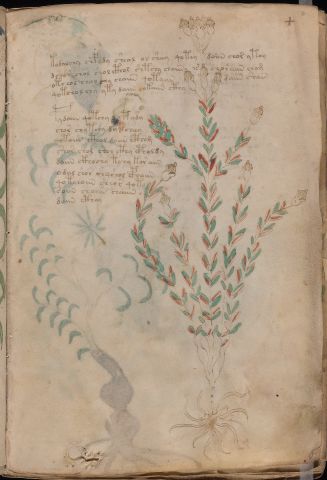
>>Link to 2014 scan (Beinecke digital library) >>Link to 2004 scan (Jason Davies Voyager) General description
This is a herbal page. For general information about herbal pages
see here.
Illustration(s)Plant with lots of tiny leaves and small flowers.
Herbal drawing characterisation (Gheuens/Rapaport):
Text
This page has 13 text items (loci), as follows:
The text is subdivided into two paragraphs, both near the top of the page. The plant drawing cuts through the top paragraph. The lines of the second paragraph are shorter and stop at the plant drawing. In the stem of the plant, just aboce the root, there are three Latin characters written above each other, which are most probably the letters 'r', 'o' and 't'. Vertically, this reads like 'rot', which is German for 'red'.
Currier language: A
Browse interlinear transliteration of f4r Tentative identificationsPossible plant identification ELV: Hypericum, ThP: Hypericum, Centaurium Erythaea (O'Neill). Other informationThe characters in the plant stem, above the root, are the most suggestive of all proposed colour annotations in the MS. In the rightmost small white flower there also appears to be a tiny capital 'F'. | ||||
| |
f4v | |
|
|
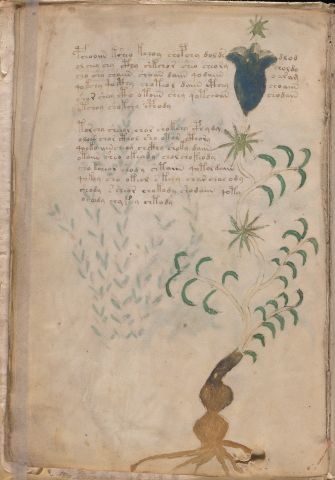
>>Link to 2014 scan (Beinecke digital library) >>Link to 2004 scan (Jason Davies Voyager) General descriptionThis is a herbal page. For general information about herbal pages see here. Illustration(s)Plant with tiny leaves and apparently two types of flowers. Bulging stem above nondescript roots. This plant shows some similarity with fragment #168 on f101r.
Herbal drawing characterisation (Gheuens/Rapaport):
Text
This page has 14 text items (loci), as follows:
The text is subdivided into two paragraphs, both near the top of the page. The plant drawing cuts through the top paragraph, leaving only one word to the right of the drawing. The lines of the second paragraph are shorter and stop at the plant drawing.
Currier language: A
Browse interlinear transliteration of f4v Tentative identificationsPossible plant identifications: ELV: ipomea? scammonia? ThP: convulvula ipomea? Other information
| ||||
| |
Folio 5 | |
|
|
|
Folio 5, together with folio 4 form a standard-sized bifolio. The folio nr. of folio 5 is on f5r. | ||||
| |
|
f5r | |
|
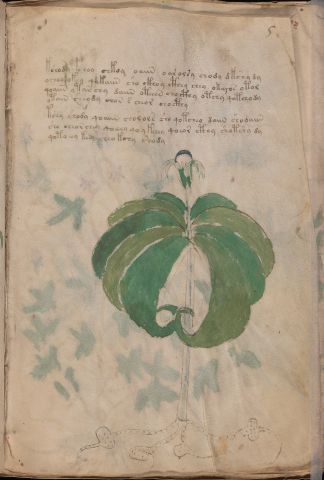
>>Link to 2014 scan (Beinecke digital library) >>Link to 2004 scan (Jason Davies Voyager) Description
This is a herbal page. For general information about herbal pages
see here.
Illustration(s)Plant drawing using primarily green.
Herbal drawing characterisation (Gheuens/Rapaport):
Text
This page has 7 text items (loci), as follows:
The text is subdivided into two short paragraphs, near the top of the page. The text is entirely above the plant drawing.
Currier language: A
Browse interlinear transliteration of f5r Tentative identificationsPossible plant identifications: ELV: paris? ThP: paris, Indian cucumber? Other information
| ||||
| |
f5v | |
|
|
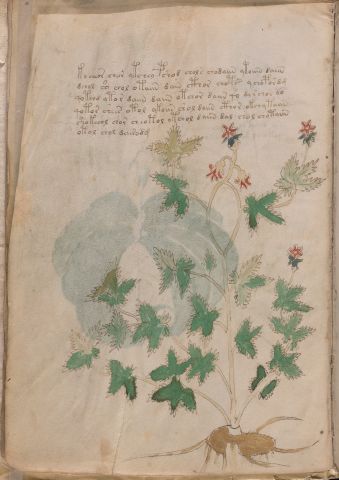
>>Link to 2014 scan (Beinecke digital library) >>Link to 2004 scan (Jason Davies Voyager) General descriptionThis is a herbal page. For general information about herbal pages see here. Illustration(s)Plant stem has impossible(?) 'loop'.
Herbal drawing characterisation (Gheuens/Rapaport):
Text
This page has 6 text items (loci), as follows:
The text is in a single paragraph, and is entirely above the plant drawing. Text
Currier language: A
Browse interlinear transliteration of f5v Tentative identificationsELV: Geranium. ThP: Parietaria (O'Neill) Other information
| ||||
| |
Folio 6 | |
|
|
|
Folio 6, together with folio 3 form a standard-sized bifolio. The folio nr. of folio 6 is on f6r. | ||||
| |
|
f6r | |
|
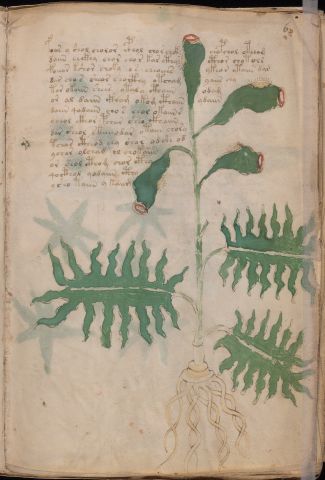
>>Link to 2014 scan (Beinecke digital library) >>Link to 2004 scan (Jason Davies Voyager) General description
This is a herbal page. For general information about herbal pages
see here.
Illustration(s)Plant drawing using mainly green. Thee are four pods each with a patch as if they are decaying.
Herbal drawing characterisation (Gheuens/Rapaport):
Text
This page has 14 text items (loci), as follows:
The text seems to form a single paragraph, at the top of the page. The first few lines are interrupted by the plant drawing. The remaining lines are shorter and stop at the plant drawing.
Currier language: A
Browse interlinear transliteration of f6r Tentative identificationsELV: Aristolochia? ThP: Asclepiades. Other informationThis plant has leaves similar to those on f51r. | ||||
| |
f6v | |
|
|
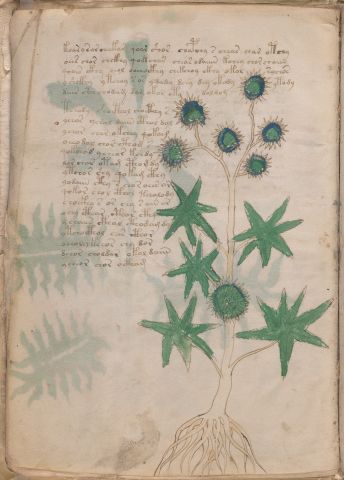
>>Link to 2014 scan (Beinecke digital library) >>Link to 2004 scan (Jason Davies Voyager) General descriptionThis is a herbal page. For general information about herbal pages see here. Illustration(s)Plant drawing using mainly green and some blue. Leaves are 7-pointed stars, and 'fruits' have spikes.
Herbal drawing characterisation (Gheuens/Rapaport):
Text
This page has 21 text items (loci), as follows:
The text is subdivided into two paragraphs, covering two thirds of the height of the page. Only the fourth line is interrupted by the drawing, with one word to the right of it. The second paragraph has very short lines which stop at the drawing.
Currier language: A
Browse interlinear transliteration of f6v Tentative identificationsThis is one of the few herbal drawings in the MS that looks like a realistic rendition of a known herb, in this case Ricinus. ELV: ricinus, castor oil plant. ThP: black gum tree? arctium? bidenus hypnis (O'Neill), castor oil, ricinus. Other information
| ||||
| |
Folio 7 | |
|
|
|
Folio 7, together with folio 2 form a standard-sized bifolio. The folio nr. of folio 7 is on f7r. | ||||
| |
|
f7r | |
|
>>Link to 2014 scan (Beinecke digital library) >>Link to 2004 scan (Jason Davies Voyager) General description
This is a herbal page. For general information about herbal pages
see here.
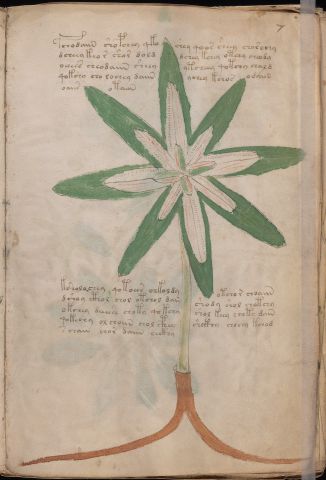
Illustration(s)Page-filling flower with 8-fold symmetry, short stem and simple bifurcating roots.
Herbal drawing characterisation (Gheuens/Rapaport):
Text
This page has 10 text items (loci), as follows:
The text is subdivided into two paragraphs, one near the top of the page and the other in the bottom half. The drawing cuts both paragraphs into two parts. In the middle of the left root, under the brown paint, two or three characters can be observed. They are barely legible. The rightmost two could be 'o' and 't'.
Currier language: A
Browse interlinear transliteration of f7r Tentative identificationsELV: paeonia. ThP: nymphaea alba, nenufar. Other informationThe characters in the left root might say 'rot', cf. f4r. Despite the size of the drawing, this could well be just a small plant. | ||||
| |
f7v | |
|
|
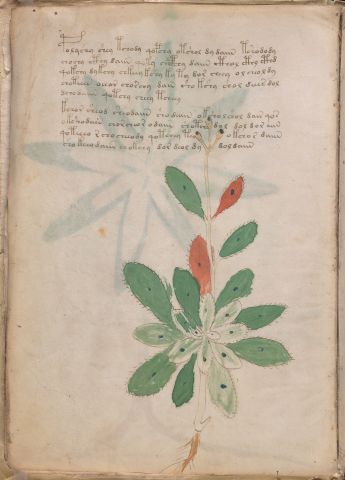
>>Link to 2014 scan (Beinecke digital library) >>Link to 2004 scan (Jason Davies Voyager) General descriptionThis is a herbal page. For general information about herbal pages see here. Illustration(s)A herb with blue dots on the leaves.
Herbal drawing characterisation (Gheuens/Rapaport):
Text
This page has 9 text items (loci), as follows:
The text is subdivided into two paragraphs near the top of the page. The plant drawing intrudes into the second paragraph.
Currier language: A
Browse interlinear transliteration of f7v Tentative identificationsELV: polygonum. ThP: polygonum persicarum (ELV), bisangia? potentilla selvaticus. Other informationPlants with blue dots on their leaves appear in other medieval herbals, most commonly juniper, i.e. in this case the blue dots represent berries. | ||||
| |
Folio 8 | |
|
|
|
Folio 8, together with folio 1 form a standard-sized bifolio. The folio nr. of folio 8 is on f8r. The quire number (Pmus) is on f8v. | ||||
| |
|
f8r | |
|
>>Link to 2014 scan (Beinecke digital library) >>Link to 2004 scan (Jason Davies Voyager) General description
This is a herbal page. For general information about herbal pages
see here.
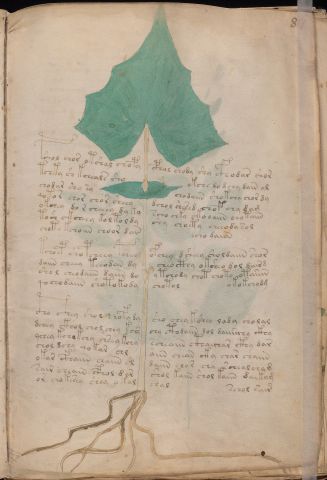
Illustration(s)The herb drawing shows a single large leaf with some additional part below it.
Herbal drawing characterisation (Gheuens/Rapaport):
Text
This page has 21 text items (loci), as follows:
The text is subdivided into three paragraphs. All text starts below the large leaf at the top of the plant drawing and all lines are cut in two by the stem of the plant. Each paragraph ends with one right-justified word ('title'), similar to f1r.
Currier language: A
Browse interlinear transliteration of f8r Tentative identificationsELV: atriplex, orache. ThP: praenanthes (O'Neill), atriplex hastata (ELV). Other information
| ||||
| |
f8v | |
|
|
>>Link to 2014 scan (Beinecke digital library) >>Link to 2004 scan (Jason Davies Voyager) General description
This is a herbal page. For general information about herbal pages
see here.
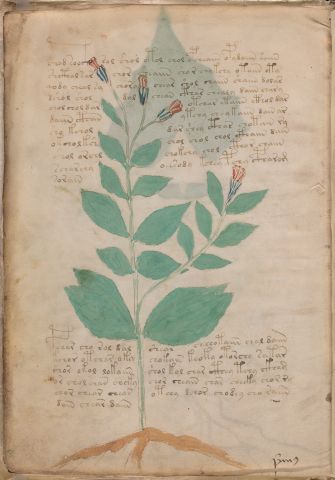
Illustration(s)Large plant drawing with plain roots, plain leaves, and blue and red flowers.
Herbal drawing characterisation (Gheuens/Rapaport):
Text
This page has 17 text items (loci), as follows:
The text is subdivided into two paragraphs, one near the top and one near the bottom of the page. The top paragraphs carefully avoids the plant drawing. All lines in the bottom paragraph are cut in two by the stem.
Currier language: A
Browse interlinear transliteration of f8v Tentative identificationsELV: oleander? verbena? ThP: silene. Other information
| ||||
|
|
|
||
|
|
|
|
|
