









|
|
|
|
|
|
|
|
|
|
The Voynich MS is a parchment codex measuring approximately 225 x 160 mm (1). It is about 5 cm thick. It has a parchment cover without any indication of its origin (year, title or author). This cover, which is a later addition and has its own story to tell, is described at the bottom of this page.
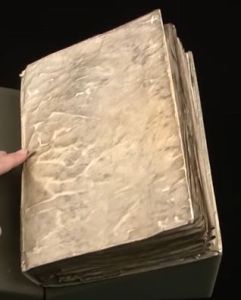
The text block of the MS consists of 102 folios (originally probably 116 of which 14 are missing) organised in 18 gatherings or quires (originally probably 20 of which 2 are completely missing). The parchment was identified in 2014 by a team at the University of York (2) to be made of calf skin, so it is vellum in the strict sense of the word (3).
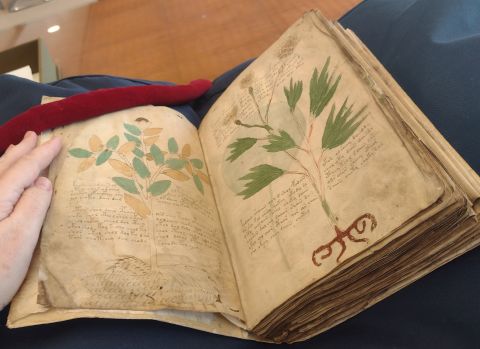
One rather unusual aspect of the MS is that some folios are of larger than standard size, and can be folded out.
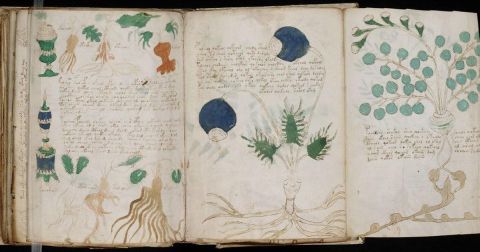
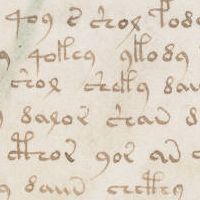
Almost the entire text of the Voynich MS is written in a an elegant, but otherwise unknown script. No other document that includes writing in the same script has ever been found. Most of the text has been written in a line-by-line manner, undoubtedly from top to bottom and from left to right. There is no sign of the application of the usual techniques for creating straight lines in medieval manuscripts, such as ruling or pricking. On many pages this results in wavy lines, although the left margin of the text is usually quite straight. In many pages it appears as if the illustration (or at least its outline) was on the page before the written text, and the text carefully avoids these illustrations.
The writing appears to be alphabetic, and includes some common shapes, and some unusual shapes. The text appears to consist of words separated by spaces. Some of these words are very frequent and may be found throughout the entire MS. Others occur only once in the entire MS. In general, the word frequency distribution shows a continuum which is typical for normal language.
In some places single words are written near elements of the illustrations. These are usually called labels. Other more complicated pages containing circular diagrams have parts of the text written closely integrated into these diagrams. In a few places in the MS sequences of short words or even single characters in the Voynich script appear.
The very few examples of writing in the Latin script are either in the margins, or look as if they could have been added by a later owner. Most of this so-called 'extraneous writing' is barely intelligible.
Until today, the text has defied all attempts at decoding. It cannot be understood, despite many decades of attempts and statistical analysis. In 1976, Prescott Currier was able to demonstrate that the text can be split into at east two different parts, with different statistical properties. He called these 'language A' and 'language B', though he pointed out that he had no evidence that these were indeed two different languages (4).
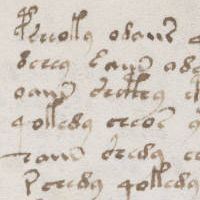
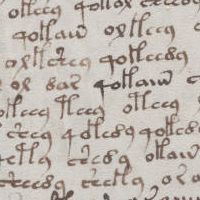
He also tentatively identified at least two hands in the handwriting of the MS, but this has now been superseded by more recent work of Lisa Fagin Davis, and five diferent hands can be identified in the MS with high confidence (5).
Given the key importance of the writing in the Voynich MS, this web site has large areas dedicated to its description, to its transliteration, and to its analysis.
Almost all pages in the MS contain illustrations of not easily identifiable herbs, constellations, or systems of tubes transporting liquids and populated by small female figures. The illustrations are largely unique to this MS. Illustrations of a similar type are mostly grouped together in the MS, even though there are a few text-only pages among them. On the basis of these groups of illustrations, authors starting with Newbold (6) and culminating with D'Imperio (7) have tentatively identified the following sections in the MS:
A dedicated page discusses these drawings in much more detail, also with numerous illustrations.
The Voynich MS is a book or codex which is composed of parchment leaves or folios, combined into gatherings or quires. A 'standard' quire in the MS consists of a stack of four sheets or bifolios which is folded in the middle to form 8 folios. Each quire is sewn onto a set of three thongs, at the combined fold. A standard Voynich MS bifolio is roughly 32 cm wide and 23 cm high, meaning that a standard folio is roughly 23 by 16 cm.
All folios in the MS have writing and/or illustrations on both sides, and the individual sides of each folio will be referred to here as a 'page'. Thus, a standard quire has 16 'pages'. The notation used to identify a 'page' in the Voynich MS follows standard usage, namely the character "f" (for folio), followed by the folio number, followed by either "r" (for recto - the front) or "v" (for verso - the reverse). Thus, the first quire starts with 'pages': f1r, f1v, f2r, f2v, f3r, etc, and ends with f7v, f8r, f8v. The 'pages' f1r, f1v, f8r and f8v together form one bifolio.
The quires in the Voynich MS have been numbered 1 to 20 (where 16 and 18 are now missing). Like many other medieval codices, several quires in the Voynich MS do not consist of the standard 8 folios. What is more unusual, though, is that several bifolios are wider than the standard size. Such bifolios have additional folds and consequently more than the standard four 'pages'. They are referred to as foldouts. These foldouts do not all have the same dimensions, and widths of the corresponding bifolios range from three to five 'pages' (instead of two). In addition, there is one even larger sheet of (approximately) 45 x 45 cm, which has an additional horizontal fold.
Every folio in the MS has a folio number written on it (8), with the numbering running from 1 to 116, though 14 folios are missing (they are listed here). The corresponding folio numbers are skipped. While these folio numbers are old, it is not likely that they were written by the original author or scribe, but rather by a later owner of the MS. This is discussed further on a page about the origin of the MS.
These old folio numbers have been written in the top right hand corner of every right-hand 'page' in the MS, while the foldouts were completely folded in. This means that they must have been added around or after the time when the codex was first bound in its current form. Due to the various different ways in which the foldout folios have been folded, the side of the leaf on which the folio number appears is not necessarily the recto side.
The official foliation adopted by the Beinecke library (9) follows the old foliation of the MS and the use of r/v as described above. The library does not propose a method for identifying individual pages (or panels) that are part of the foldouts. For this purpose a de facto standard will be adopted here. This method was already used (and probably first introduced) by Anne Nill somewhere between 1930 and 1960, as evident from collation notes still preserved in the Beinecke library (10).
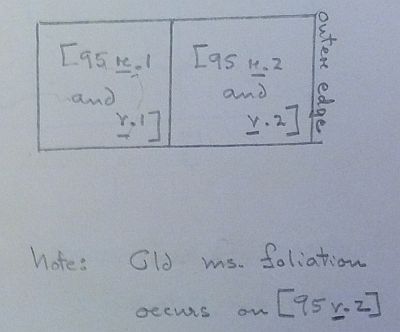
It was also followed by D'Imperio in her reference work of 1978 (11). It was described in detail by Jim Reeds in 1995 (12), and the following description borrows heavily from his.
When any foldout is completely folded out, to the right of the binding gutter one sees the recto side of this folio. To the left is the verso side of the previous folio. If the folio nr. is (for example) 72, the recto 'pages' of the foldout are numbered left to right (i.e. away from the binding): f72r1, f72r2, etc. On the verso side (with the binding to the right) the 'pages' are numbered right to left (again away from the binding): f72v1, f72v2, ...
This is illustrated below for the single bifolio in Quire 11, where the red mark represents the binding. To its left we see the standard folio f71 and to its right the multiple foldout folio f72 already mentioned above:

The creases of the foldout folios sometimes form boundaries between distinct 'pages' and sometimes do not. That is, continuous lines of writing sometimes (though rarely) cross foldout creases. An example of this is the page f72r3 included in the above illustration.
A special case is the pair of folios f85 and f86, which form the above-menioned multiple-foldout with the horizontal folding crease. It is explained in detail on a dedicated page.
The above-mentioned convention for numbering individual parts of foldout folios will be used throughout this web site. It has also been adopted in some other internet resources about the Voynich MS, for example the very useful >>Voynich MS browser by Jason Davies.
The following 14 folios are missing from the MS:
An additional set of numbers appears in some older photocopies of the Voynich MS. In 1931 Theodore Petersen was allowed to make a complete photocopy of the Voynich MS (14), and all 'pages' were numbered in white ink, and circled, on the negatives (15). These 'page' numbers, running from 1 to 236, were used for several decades after they were introduced, for example in the early computer transliteration efforts initiated by William Friedman (16), and in the landmark paper by Prescott Currier (17).
Quire marks are written on one folio in each quire. It is not known when or by whom these were written, but these marks are typically added just prior to the time of binding a codex. The style of the numbers appears clearly older than the folio numbers. They are indicated with an arabic numeral followed by a 9 for Latin -us, and sometimes an 'm' in between (18). Quire marks 16 and 18 are missing, and from the missing folio numbers between quires 15 and 17 and between quires 17 and 19, one may tentatively conclude that these quires consisted of one bifolio each (which may or may not have been foldout folios), and that these single bifolios were lost. This also suggest that, at the time when the folio numbers were added, these quires were not missing.
The quire marks are written on the verso side of the last folio of each quire, with two exceptions. One exception is quire 9. In this case the quire number would have been in the 'correct' place if this single-sheet multiple foldout quire had been bound into the MS in a different manner. The other exception is quire 20 (the final quire), where the quire number is on the recto side of the first folio.
Nick Pelling has suggested that the quire numbers are in several different hands (19). What is certain is that quire numbers 19 and 20 are different in at least one respect, because they have not been written as ordinal numbers with the trailing 9 (-us). This topic is treated in more detail on a later page.
A formal collation in accordance with bibliographical standards has been prepared by Lisa Fagin Davis (see note 5) and will be included here once the paper in which this appeared has been published.
 |
A visual collation of the MS. |
The >> Beinecke library description of the Voynich MS calls the cover of the MS a limp vellum cover of the 18th - 19th C. This tells us that the cover is not original to the MS, and in all likelihood replaced an earlier cover. This exchange of the cover of the MS was done by the Jesuits of the Collegium Romanum in Rome. Very similar covers are found on numerous manuscripts that were kept in the same Jesuit library in Rome. The present cover is made of goat skin, as determined in 2014 by Jesse Meyer of Pergamena, a professional parchment maker.
|
The binding of the MS. |
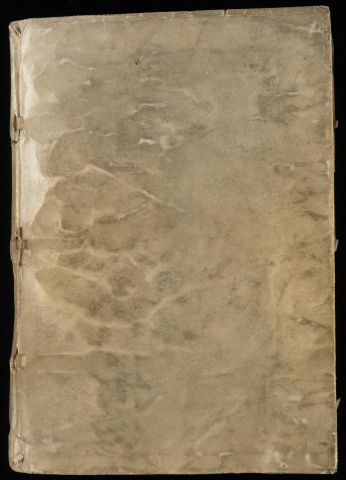
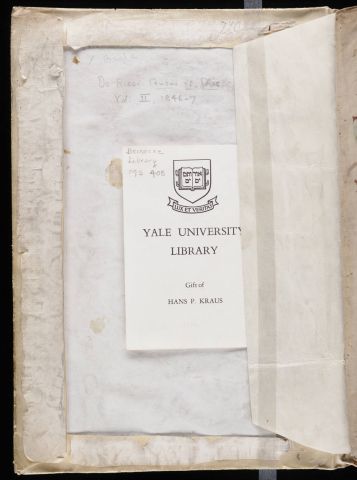
While the cover is described as a limp cover, this is not what it was made to be. It used to be stiffened by filling materials. The cover also shows remnants of paper pastedowns (see right-hand picture above) that have been removed. The pastedowns and the filling materials were most probably removed by Wilfrid Voynich himself, shortly after he acquired the MS.
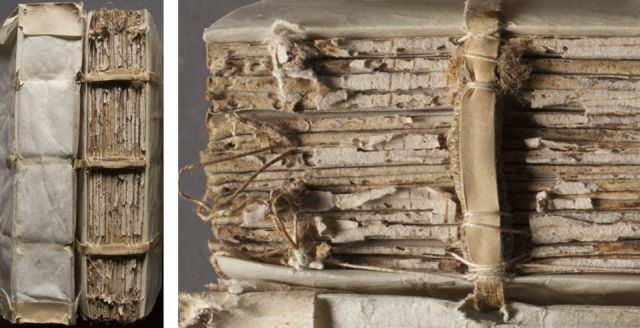
Details of the stitching are shown in the above illustration (20). The leather thongs were added in the 1960's, and glued on top of the old, possibly even original (fifteenth century) thongs, that were made from some kind of fiber. This was a repair made in order to stabilise the binding. The white thread visible in these figures also dates from the same repair.
There are pencilled annotations on the inside of the front and back covers, which are all from after 1912, and can be ascribed with confidence to four different people: Wilfrid Voynich, Anne Nill, Hans-Peter Kraus and Hellmut Lehmann-Haupt.
|
Pencilled annotations on the inside cover. |
|
|
|
|
|
|
|
|
|
|